The last week of March saw this topic come into the news. That is not surprising since the Mayor of London,Sadiq Khan, had the naming of the Overgroundlines in his election manifesto.
I have found only three sites that talk about it. Jago Hazzard runs a regular series on You Tube called "Tales from the Tube", which looks at different aspects of the London Underground/Overgroundand DLR. With regard to this topic, namingOverground lines, he came up with a report called,"Naming the Overground Lines, and why £4 million actually isn't that much."
https://www.youtube.com/watch?v=gKBkb3H3Abk&t=83s
Another site, "Business Traveller", had a news piece called, "TfL to rename six lines on the Overground."
On the Forum page of that website a topic was introduced called,"Name or number Overground lines?"The point this blogger wants to make is that I am in favour of numbering the lines not naming them
The website, "London Reconnections" provides an extensive and interesting analysis of the question of naming Overground lines. The problem lies in the statement at the very end of the blogg when the author states, "As Mayor Khan stated that the new Overground lines will be named,
not lettered or numbered, we shall not brook any numbering or lettering
suggestions in the comments." This suggests that the rest of the, very good, blogg cannot be taken as seriously as intended.Does it mean that what the Mayor says is unmovable or incontestable? Cannot he make a grave mistake? At least look at the arguments in favour of alternatives.
"The Flowering of Overground lines & colours – How Soon is Now?"
The experiences of metro and surburban lines all over the globe should surely be taken into consideration. There are innumerable cities which use numbers why should London be necessarily different?
With regard to the Underground, we have reached the stage where there are many different lines and colours so any more would need shades of colours, not separate colours and different names. The TfL map is already rather cluttered so more colours and named lines would only make it more cluttered without giving us the benefit of differentiating between Underground and Overgroundlines. The Overground lines have their informal names, and without doubt some people would continue to use them. However, we have to remember that the greater use of the maps identifying the lines is not made by the regular commuter but the occasional traveller, the tourist, and others who do not know the system, or that part of the system where they wish to go.
Other lines have been earmarked for transference to Overground. Basically what TfL wants are for all above ground rail lines within the London boundary to be converted to Overground lines. This means that these extensions should be taken into consideration.
Examples of this mean that the loop lines, through Hounslow and Kingston out of Waterloo will be incorporated as will the loop lines out of London Bridge through Greenwich, Sidcup and Lewisham. The only part missing is the link from Waterloo to London Bridge, not an extensive distance to tunnel. It also frees up platforms at both termini for other regional or long distance services.
Other South West train services into Waterloo from Shepperton, Hampton Court, and Chessington South could join up with the lines out of Liverpool Street station to Chingford,Enfield Town and Cheshunt. These need a connecting tunnel between the two termini but will free up more platforms at the termini for other services. These would need a cross London tunnel connection. What better than use and substitute the existing "Waterloo and City Line"? This line already runs under Blackfriars before reaching Bank and it is no great effort to extend it to Liverpool Street. A lot could be saved off costs this way and thus make the line more useful.
The Wimbledon / Sutton / Mitcham Junction,loop run by Thameslink at present, is a prime candidate to be passed over toOverground. It is entirely inside the London area so should be passed over.The most likely connection north of the Thames would be that part of the UndergroundCentral Line to the Hinault loop.
The Southern Railway lines out of Victoria and London Bridge that go to Epsom Downs, Tattenham Corner and Caterham would also be incorporated into the Underground.
This is the present Overground map as presented by TfL.
O1/O2/O3/O4) ......Waterloo - London Bridge...... (This section would be of new construction. The common part of the route for lines 01 to 04 is in reality from Clapham Junction - Waterloo - London Bridge - New Cross - Lewishham either out or return)
O1) ......London Bridge - Greenwich - Belvedere - Welling - Lewisham - New Cross - London Bridge......
O2)......London Bridge - New Cross - Lewisham - Welling - Belvedere - Greenwich - London Bridge......
O3)......London Bridge - New Cross - Lewisham - Welling - Bexley - Hither Green - Lewisham - New Cross - London Bridge......
O4)......London Bridge - New Cross - Lewisham - Hither Green - Bexley - Welling - Lewisham - New Cross - London Bridge......
O7) Chessington South - Raynes Park - Clapham Junction - Waterloo......
O5/O6/O7) ......Waterloo - Blackfriars - Bank - Liverpool Street......(The fully shared track would run from Raynes Park - Clapham Junction - Waterloo - Liverpool St. - Hackney Downs).
O5) ......Liverpool Street - Hackney Downs - Walthamstow Central - Chingford
O6) ......Liverpool Street - Hackney Downs - Edmonton Green - Enfield Town
O7) ......Liverpool Street - Hackney Downs - Edmonton Green - Cheshunt
O8) ...Sutton - Mitcham Junction - Tulse Hill - Elephant & Castle - City Thameslink - Kings Cross - Finsbury Park - Manor House - Stamford Hill - Leyton Midland Road - Leytonstone -Woodford - Roding Valley - Hinault - Newbury Park - Wanstead - Leytonstone - Stamford Hill- Finsbury Park - City Thameslink - Tulse Hill - Tooting - Wimbledon - Sutton ...
O9)...Sutton - Wimbledon - Tooting -Tulse Hill - Elephant & Castle - City Thameslink - Kings Cross - Finsbury Park - Manor House - Stamford Hill - Leyton Midland Road - Leytonstone - Wanstead - Newbury Park - Hinault - Roding Valley - Woodford - Leytonstone - Stamford Hill - Finsbury Park - City Thameslink - Tulse Hill - Mitchum Junction - Sutton ...
While we are looking at the Overgroundlet us also look at the Docklands Light Railway(DLR). It is difficult to make any provision when we do not know any concrete plans for this network. The only thing I have clear is that it will be extended,.....but to where and when I do not know.
This is the present DLR map as presented by TfL.
(c) TfL
https://content.tfl.gov.uk/dlr-route-map.pdf
DLR Line Numbers
DLR1) Bank - Canary Wharf - Lewisham
DLR2) Stratford - Canary Wharf - Lewisham
DLR3) Bank - Canning Town - Woolwich Arsenal
DLR4) Stratford International - Canning Town - Woolwich Arsenal
DLR5) Tower Gateway - Canning Town - Beckton
Maps of two cities, among many, which use numbers for their Metro and/or surburban lines
Munichshowing: U-Bahn, S-Bahn and Regional railways
These are plans for the Overground and DLT services for the foreseeable future. However, the article does not take into consideration known or proposed projects for the other train services in and into London, as well as some tidying up that could/should be done. These will be looked at in the next article.
Seeing this news piece, which seems at worst fake news and at best pure journalistic speculation, brought to mind the processes being put into action and those that will come into the headlines in the near future. *****”IAG mum on TAP privatisation being its “Plan B”,” (17-2-23, ch-aviation)
This appeared after this other piece hit the headlines just before it….... *****”Air France-KLM Is Interested In Buying TAP Air Portugal,” (17-2-23, Simple Flying).... .....which by far is the more interesting piece of news.
To put things into perspective it should be pointed out that Air France has had a long term interest in buying Air Europa with its plethora of routes into South America. IAG wants to checkmate that interest by offering to buy Air Europa and so make Madrid Barajas the main gateway to Latin America, all under the Iberia flag. If IAG is not successful in its bid for Air Europa then Air France will be free to change its bid from TAP back to Air Europa. The likely outcome is for IAG to take over Air Europa, but be prohibited from taking over TAP, which will go to AF/KLM.
Iberia already forms part of the IAG group. Its interest towards Air Europa goes back to 2019 when IAG bid €1000 million for the group but this was immediately considered too much with the oncoming coronavid19 epidemic. Thus it was reduced to €500 million. It would most likely have been accepted in order to keep Air France/KLM out of Barajas airport but was scuppered by the epidemic. As a result the original conditions were renegotiated to permit IAG to buy Air Europa for €500 miiion. IAG took advantage of that to take a slice of 20 per cent of Air Europa instead of the payback of a loan of €100 miilion previously made to Air Europa. So I see no competition problem in IAG taking over the holiday group.
The European Competition Authorities had already laid down to IAG that its bid for Air Europa would be subject to examination with the likely outcome of IAG having to make concessions to get approval of the deal. After that it is highly unlikely that IAG would bid for TAP. The European Authorities would not accept consolidation of all principal long-haul services in the Iberian peninsular passing into the hands of only one company. Therefore, one can safely say that if IAG goes ahead with its move for Air Europa then it will not make any move for TAP.
The matter changes, however, if IAG were prohibited from taking over Air Europa. This would leave it with a still strong desire to strengthen its position in South America. TAP has a good network in South America but to a plethora of routes in Brazil which makes it so attractive. Thus the position would change dramatically. TAP would be open to IAG while AirFrance/KLM would have easy access to Air Europa - which is what it always wanted.
As a Result of that one can easily see that anyone interested in buying TAP would be put under the microscope by the competition authorities. If Iberia is given the go-ahead to buy Air Europa then the most likely outcome would be for Iberia to be prohibited from buying TAP. On the other hand, if Iberia is prohibited from buying Air Europa then it will be free to bid for TAP.
On the other hand the Lufthansa group is not lying idle. At the moment it is embroiled in an attempt to take over the new national Italian carrier — ITA. Here it is likely to be successful. Its subsidiary, Eurowings, has started to coddle up to Volotea. The presence of LH´s Eurowings subsidiary in ever widening markets in Europe makes it appear to be an ever increasing aggressive operator.Its chosen new partner, Volotea, is a spin-off from Vueling. It is well run and opens latin markets in Europe,(Spain, Italy and France). *****”Germany’s Eurowings, Spain’s Volotea sign sales partnership,” (17-2-23, ch-aviation)
This move throws the gauntlet down to both IAG (with its Vueling subsidiary) and AF/KLM (with their Transavia subsidiaries) What will they do after this is done? They have to expand to be meaningful in the low cost market. What is their future, to merge with JET2, Condor, TUI, French BEE, Corsair or one of the other LCCs or Charter Airlines? Ryanair seems big enough to survive but what will happen to Easyjet and Wizzair? Are they to be prey or predators? Three others are interesting to note (the reborn) Norwegian as a short/medium haul carrier, Air Baltic (an efficient aggressive airline flying from the Baltic States), and the long-haul low cost airline Norse Atlantic.
Of the remaining full service airlines there seem to be three or four that are not already in their likely predetermined destinations. Finnair is in ONEWORLD and seems likely to end up in IAG. Both SAS and LOT are in Star Alliance, but I cannot see them both being taken over by Lufthansa. One,yes, but both, no. Another remaining medium sized airline is the czech, charter, regular service SMARTWINGS, .......................
.............. together with CSA Czech Airlines, which initially lies within the Skyteam alliance. On top of that we have Aegean(Greece)in Star Alliance,Tarom (Skyteam),Turkish Airlines (in Star Alliance but able to exist alone as it has an extensive route network from its hub in Instanbul - just like the Middle East Megacarriers.)and Aeroflot(Skyteam) (which I doubt will now ever form part of the European group of airlines). Most of the remaining airlines are too small to be taken into consideration but could well be bought out or allowed to go to the wall.
All this means that everybody is on the block and up for grabs. Anything can happen from now on.
It is a surprise that so soon there have been developments of this news.
This blogger published the blog in the evening of 22 February. About 24 hours later he heard about the purchase of the outstanding 80 per cent of Air Europa (Globalia) not already owned by IAG.This was published in the press of today (24 February) as well as being published on IAGs own website..........“IAG agreement for full acquisition of Air Europa,” (24-2-23, IAG)
--Euros 100 miilion in shares in IAG (equivalent to about 1per cent of the company)
--Euros 100 million in cash to be paid on the first anniversary of the signing of the deal in 2024.
--Euros 100 million in cash to be paid on the second anniversary of the signing in 2025.
--Previously IAG paid the Hidalgo family, in 2021, Euros 75 million, compensation for the deal not going ahead.This will be deducted from the final price.
--IAG will take on the Euros 574 million net debt which the Globalia group had at the end of 2021.
There are other minor points which are still important but do not fundamentally change anything. The main point is that the real sales price is near the Euros 1000 million which was initially agreed upon in 2019.
Originally, the European Competition Authorities thought that the deal was too much with regard to Iberia and Air Europa – maybe there was some French lobbying in the background. Now there seem to be no objections, so Air France/KLM have an open road to taking over TAP. However, others will insist that Air France pay back all government aid it has received before the all clear is given.
Already, the can of worms has been opened with speculation that Norwegian and Easyjet are on the block. There are many possibilities, so let us see.
(Up to date information provided by the economic dailies Expansion and Cinco Dias - 24-2-2023)
We have to make a short diversion to see why there is a need for a third runway at Heathrow. For many years after its opening in 1946 Heathrow was pushed as "London Airport", without making any distinction with other airports in the south east of England. This was to be the country´s hub airport, with six runways, where you could fly to anywhere. The airlines of other countries took this on, to such an extent, that when the government wanted to extend the use of Gatwick and Stansted (in the early 1970s) by sending the foreign airlines to operate from these airports, they answered with a resounding, NO.
The independence of ex-colonial territories in the 1950s and 1960s meant that each new country wanted to set up its own airline, partly as an expression of identity.One of the logical places to fly firstly, was the home of the former colonial power. The frequency of the flights only partly depended on economic need but there was no free-for-all. Agreements were drawn up between trading partners which split the market between the two countries´ airlines. Frequently, BOAC (or BEA) occupied the UK quota while the other country designated its own (usually state-owned) airline. Sometimes other national carriers were permitted to participate so we saw the introduction of international flights flown by airlines such as British United Airways(BUA), British Eagle,BKS, British Midland, Laker and later Virgin Atlantic. However, this was always within the 50% quota of traffic between the two countries. (Take note that it was not always the traffic between cities but between countries.)
This form of transport division was kept going until the US President Reagan´s era when his administration wished to open the traffic across the North Atlantic and do away with the so-called Bermuda agreements which had dominated thinking for about 35 years, since the end of World War 2. With Reaganites at one end of the negotiating table while Thatcherites were at the other end, as both were on the same wavelength it did not take long for both to reach an agreement. This successful outcome became the norm for agreements signed elsewhere - especially with the European Economic Union (EEU) which the UK had joined in the 1970s.
How did these changes affect Heathrow (LHR)?
With regard to the USA/UK market, there had been two US airlines flying into LHR. Originally these were Pan Am and TWA. Any other US airline had to fly into Gatwick or Stansted. With the collapse of those two US airlines they were replaced by United and Delta plus American Airlines. Now any airline which can obtain the slots can fly into Heathrow. The British airlines into/out of Heathrow are British Airways(BA) and Virgin Atlantic. Now no other British airline has shown an inclination to take up the rights to fly from LHR. Those that have , in recent years have used Gatwick (Norwegian and its successor, Norse Atlantic). Others have made no impact. The US airlines now see the addition of JetBlue to New York and later, in 2023, to Boston.
The airlines of other countries have mostly used their rights to fly into LHR and to/from nowhere else. There was one exception when Air France tried to operate a flight from LHR to Los Angeles but it did not last long and nobody else has tried to do the same. Air India and Kuwait Airways originally had transatlantic flight rights to New York, but these have been allowed to lapse.
The present situation is that BA dominates usage of the airport with exclusive use of Terminal 5 but also uses Terminal 3. Flights from other members of its group owners, IAG, also fly into T5 while so do some from the oneworld alliance partnership.
Virgin Atlantic started its operations from Gatwick and then spread to LHR when slots became available where they flew from T3. Now they have as owners Delta airlines with 49% of shares but effectively complete control. The Virgin group has the remaining 51%. From 2022 the airline has decided to abandon Gatwick and concentrate all its efforts at LHR. Here it flies from T3 alongside its part owner Delta. Also it has decided to ally itself with Delta in the Skyteam alliance with KLM and Air France. That way it hopes to pick up any slots it may need from its partners.
You can then see that any more slots it may need will have to come from an increase in runway capacity. This leads us to a third runway at LHR and by extension a second at Gatwick. BA has returned to Gatwick with holiday routes, while most of the other capacity there is occupied by Easyjet and Wizzair. IAG is using Gatwick to extend the network of routes flown by its subsidiary, Vueling, as well as its newly set-up Gatwick based subsidiary BA Euroflyer. No doubt Air France and KLM will copy that tactic by increasing the slots for their susidiaries, Transavia (France and Netherlands), and Lufthansa will do the same with its subsidiary, Eurowings. Others will also do the same especially when they want a good airport with good connections, but they are unwilling to pay higher charges imposed by LHR.
As
a result of this then, to satisfy demand, airports should be provided with the means to
build second runways (in the case of Heathrow a third). Gatwick wants to
use a taxiway as a second runway. This is not ideal as both cannot be
used at the same time. It has set aside land for a second runway
parallel to the existing first runway. Let Gatwick build its second
runway when it sees fit. Do not give permission for an additional
terminal that way we can have part of the necessary infrastructure up
and ready for when it is needed. However, the limitation of
expansion of the passenger capacity of the airport remains in place, if that is
the decided option.
The
question of other airports is varied but all the main ones should have a
two runway capacity at least.Why two runways? This is a fundamental
question for all the airports. If the main runway is out of use what
alternatives exist? Accidents on the one hand do happen while
maintenance of the runway operations is an ongoing necessity. These
factors alone demand that the airport should be able to offer a reasonable alternative
to its customers - - - the airlines, the passengers and the freight
hauliers who use the aircraft do not want delays nor inconveniences so
would applaud such a measure - - - to increase the possibility of
increasing the use of the runways at the airports.
This measure does not mean drastic massive construction. In fact the majority of our airports are old military airfields so have other runways already constructed. However, for modern aircraft they would need to be extended (and widened). As a "rule of thumb" for jet operation runways should be about 2000m. long as a minimum. For large, widebodied, long-distance aircraft we would need runways of a 3000m length (in general terms) - smaller aircraft, not so lengthy runways.
Let us take a look at the airport situation in the United Kingdom.
1-Inverness:1780m. Two crossover runways provide alternatives but with limitations on their extension.
2-Aberdeen: 1950m. which could be extended. A second parallel runway of equal length would need to be constructed using taxiways. No other possibilities exist onsite.
3-Dundee:
1400m. This runway could be extended to about 1570m. but he site is too small and unsuitable for another runway. Edinburgh is a
relatively short distance away to be used as an alternative.
4-Edinburgh: 2560m. There exists the possibility of using parallel taxiways as an alternative runway. Better still, land is available for a second parallel runway north of the main runway.
5-Glasgow: 2650m. There is no possibility of a second runway. Edinburgh and Prestwick are alternatives.
6-Prestwick: 2980m. Already has two crossover runways at 90º The SW to NE runway could be extended up to 3000 m.
7-Carlisle:1830m. In
addition to the present main runway there are two crossover runways.
These should be maintained with the possibility of extending them to
2000m. even though they are not needed at present because the volume of traffic at this stage is so low.
8-Newcastle: 2330m. The only possibility is to reserve land to the north so as to construct a parallel runway of about 2000m.
9-Teeside: 2290m. A
new east-west runway could be constructed using part of the old
infrastructure. The alternative is to reserve land as at Newcastle.
10-Blackpool:
1870m. If this airport were ever to be reopened then the present runway could
be extended, while the only alternative would be a runway using part of
the old infrastructure in a SE - NW direction.This, however, would be
limited to about 1500m. max.
11- Leeds/Bradford: 2250m. No land is available on site at the moment. However, land is available for a second parallel runway within a reasonable distance (about 2000m) from the airport.
12- Humberside: 2200m. An old crossover runway could be used as backup but by extending it to 2500m. if needed.
13- Doncaster/Sheffield: 2890m. It has recently been announced that the owners are to close this airport. There is not enough traffic after the withdrawal of Wizz. However, if one were needed then using the parallel taxiway might be an alternative.
14- Manchester: 3050m. Britain´s most important airport outside the South East of England. It already has a second runway parallel to the main one. They are too close together to be operated independently. They complement each other as do the two runways at Gatwick. In the long term an independent second runway would be more advisable.
15- Liverpool: 2280m. It wants a second runway which has not yet been conceded. The traffic is mostly domestic (British Isles) and holiday --- Spain, Italy, Greece, Turkey etc.
16- Birmingham: 3050m. This airport is too close to London to offer a real alternative to the capital´s airport offer. However, that said, there are a number of long distance services offered from the airport - particularly to India and Pakistan. The potential is there to increase the traffic. The parallel taxiway might be able to be converted into an alternative.
17- East Midlands: 2890m. An important airport for freight, especially Royal Mail, but also used by holiday airlines. The possibility exists of using the parallel taxiway when needed.
18- Norwich: 1840m. An area which has a certain importance but is out of the way. So the airport at most could provide connecting services within the British Isles and to Brussels and Amsterdam. There is a crossover runway of 1740m. for use if necessary.
19- London Stansted: 3050m. This was pushed to be London´s second airport in the nineteen sixties and seventies. However, as the Thames estuary plans were rejected so were these. Since then the powers that be have tried to push forward its candidature by getting award winning terminals built. Its rail connection to Liverpool St. Station is rather long because of the crowded commuter lines. That does not mean the airport should be ignored,.... but certainly placed after Heathrow and Gatwick in importance. A second runway would have to be built outside the present limits but in an emergency one of the taxiways could be available.
20- London Luton: 2160m. The north London airport with great potential, serving that part of London but also it could serve passengers arriving from all parts of the north who would not need to pass through London itself. It is bettering its infrastructure in a haphazard manner with no overall plan. The topography would make any construction of a second runway difficult but necessary.
21- London Southend: 1850m. This small airport is often seen by some operators as an alternative to London City. It is or has been used by Easyjet, Ryanair and Wizz at different times. The rail connection to London is good. A second runway is only possible on a greenfield site at some distance. No other on-site possibility exists.
22- London City: 1510m. The limitations of the old docklands and the river itself restrict any extension of the airport runway without ridiculous expenditure. So the airport is and will remain focused on London´s financial centre with only one runway.
23- London Gatwick: 3300m.The limitations of having a second runway were lifted in 2019.
Image caption,
Gatwick
identified three options for a second runway, but the Davies Commission
shortlisted Option 3, which would allow fully independent operation.
There is room for another runway but no permission has been sought nor given for such a construction. So Gatwick is using its taxiway (parallel to the main runway) as a second runway when needed. This is only a short term temporary solution to overloading/overcrowding.
Gatwick Master plan, page 94, section 5.4 "Safeguarding for an additional runway to the south". page 168, Plan 20 Airport Layout - additional runway : the pointer marked 13
The prefered option is the most southerly of the three shown in the image.
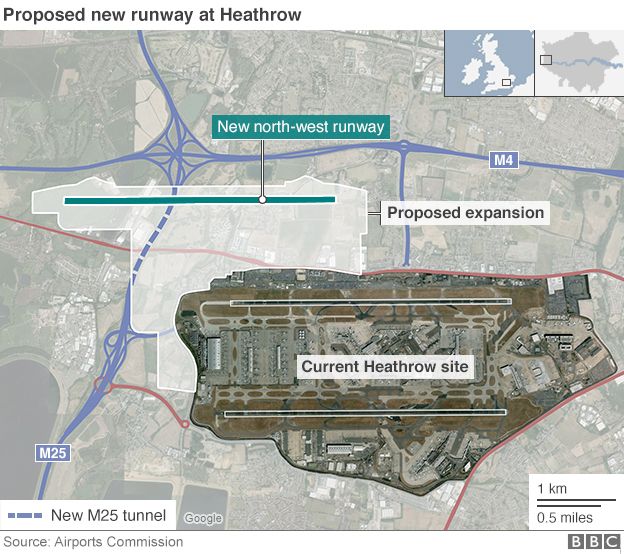
24- London Heathrow: 3900m. It has been known for some years that Heathrow needs a third runway. However, the pandemic put a stop to that need as passenger numbers plummeted. Now they are nearing 60-70 % of 2019 figures but still below the 75 million which Heathrow achieved. I would think that the airport´s own plans for a third runway should be scaled down as their size and complexity are not needed, though the third runway is.
"Heathrow Airport Expansion - Consultation Document", June 2019
I am not in favour of the present siting, as indicated in thge image. The runway should not cross the M25 but be more to the east so that it crosses the rail lines from the north to Terminals 2 & 3. Therefore, a new station could be built underground up to the new terminal (1?) above it. This would make it most acessible and less expensive.
25- Southampton: 1720m. This airport needs to expand to become viable. It reckons it needs 1.2 million pax. annually. It could be expanded and has the necessary permission to 2000m. which would permit the airport to operate with small and medium jets up to the A320 family.
"UK’s Southampton Airport: part two – 2019 levels ‘unachievable’ without runway extension", (CAPA.com, 27-10-22)
26- Bournemouth: 2270m. Used by Easyjet as well as others. This airport has a crossover runway which could be used as a second one.
27- Bristol: 2010m. An important Easyjet hub. A second parallel runway would have to be built to the south outside the present perimeter, though the parallel taxiway could be used in an emergency.
28- Exeter: 2080m. A parallel second runway would have to be built to the northeast of the present site, though a crossover runway of just about 1000m. could be available for small aircraft. There would be no chance of extending it.
29- Plymouth: This airport was closed and mothballed in 2011 with the site being preserved. It has at most a 1200m runway with no room for expansion.
30- Newquay/RAF St.Mawgan: 2750m. This airport is becoming increasingly popular. It will continue to do so as it aspires to become Britain´s spaceport. A 1700m (extendible) crossover runway could be brought into use if necessary.
31- Cardiff: 2400m. This airport only remains open thanks to the Welsh Gov. A crossover runway (SW-NE) could be developed and extended if necessary.
32- Anglesey/RAF Valley: 2290m. I think the RAF would dictate its own needs here as the passenger flights are few and far between. A north/south crossover runway could be developed and extended if necessary.
33- Hawarden: 2040m. Last used on a regular basis as a stopping point by British Eagle on some of its Liverpool flights to London. Now it is for Airbus Beluga (and other) flights to other Airbus plants. No second runway needed.
34- Isle of Man: 1750m. (This could easily be extended to 2000m) There is an opportunity to build a runway parallel to the main runway on the existing taxiway. Also one of the out-of-use runways, south-west to north-east, could be extended, to about 1600m., to be used as an alternative.
35- Belfast City: 1730m.,though could easily be extended to 2600m. There is no room for any alternative runways. Belfast International would be the solution.
36- Belfast International: 2780m A perpendicular crossover runway of 1800m already exists.
37- (London)derry: 1860m. A crossover runway could be brought back into use of up to a length of 1770m. in the NW-SE direction.
38- Jersey: 1600m. There are no possibilities for alternatives.The main runway could be extended up to 2200m.
39- Guernsey: 1460m.There are no possibilities for alternatives. The main runway could be extended up to 2000m.
40- Alderney: 880m The runway is short and cannot really be lengthened to more than 1160m. It is also irrational as the traffic is basically connecting Alderney to Jersey and Guernsey with turboprop aircraft with limited capacity. If there were such greater demand, flights could operate to Exeter, Southampton and the nearest airports in northern France.
Here I have pointed out all the airports in the UK (except the Scottish islands). Possibilities exist for alternatives in case of need. They do not have to built at every airport but should be taken into account and the necessary land reserved where needed. That way unnecessary expense can be avoided in the future when the case arises. We only have to look at our truncated railways to see how difficult it can be to recuperate lost land which was originally dedicated to the transport system.
However, since we are only really looking at the cases of Heathrow and Gatwick I am sure it is quite clear what has to be done. People do not make the majority of the noise and the pollution but the aeroplanes and their supporting machinery. Reduce their impact and you can solve the problem. The introduction of hydrogen and electric power could lead to substantial improvements. Let us go ahead with them and so we would be able to enjoy our flying again without a guilty conscience.

 (c)TfL
 (c) TfL