Showing posts with label Thameslink. Show all posts

11 February 2015

Business airlines

That "La Compagnie" is starting business only flights from London to New York (Newark) as reported in Business Traveller (3-2-15) can only be welcomed. The business traveller might well ask why he/she cannot get that bit extra exclusivity when paying that (large) extra on a trip.

 "La Compagnie launches all-business London-New York flights" (Buying Business Travel 3-2-15)

 "French airline offers 'business class at Ryanair prices' as it slashes £1,000 off its flights from London to New York"   (Mailonline 4-2-15)
 
 "French firm starts 'budget business' class flights from London to New York" (London Evening Standard 4-2-15)


The previously failed experiences of "Eos, Silverjet, and Maxjet" makes one think that the concept was wrong. However, this begs the question. Those airlines tried to survive, unsuccessfully, during the biggest economic downturn in 80 years.

On the other hand British Airways, firstly, founded "Open Skies" and then took over "L´Avion" to fly from Paris Orly to New York. This has proved an moderate success. It changed its name unnecessarily  and then floundered to find the product it wants to present - which is still the case.

Obviously, the founders of "L´Avion" were bought out with the condition of not setting up any sort of competition for a certain period. That period will have finished since now, of the top six executives in La Compagnie four have previously worked in L ´Avion and/or Open Skies

Now we have the founders of the original idea, "L´Avion" setting up "La Compagnie". The new company starts flying Paris (CDG) to New York in July 2014. However, such is the confidence by them, and in them by their backers that it now proposes to fly London (Luton) to New York from late April.The frequency will be three times weekly, rising to six times weekly in June and eventually daily by the end of the year.

"Open Skies" still operates from Paris Orly to New York (JFK and Newark) and has not developed since then despite markets existing in Brussels, Amsterdam, Geneva and maybe even in Nice(without thinking about other countries or languages).
It flies B757-200s in two different configurations: a) 114 seats  with 20 Biz Bed(business class seats), 28 Prem Plus (premium economy), and 66 Eco (economy seats), while the second option b) offers 112 seats with 20 Biz Bed, 20 Biz Seat and 72 Eco seats.


To be fair to BA, it has had to accept that its all business flights from London City to New York are not part of the same subsidiary, that operates "Open Skies". This was due to union oposition. As a result, however, both "Open Skies" and the operation from London City operate separately.  This second option was originally operated from London City from 2012 by British Airways (BA) Limited under the brand name Club World London City. However, from 2015 The Club World London City services are being returned to being operated directly by British Airways PLC.


The aircraft leaving London City cannot take on all the fuel necessary to make the transatlantic leap all in one go so provides a stopover on the outward flight at Shannon. This has given them the chance for the passengers to pass througn US Border Controls in Ireland so saving that time on arrival - no small benefit. They, therefore, arrive as domestic passengers and so save a lot of time and avoid the hassle which could be a couple of hours otherwise.The problem of loading weight for the return flight does not exist so the flight is direct New York JFK to London City.
The aircraft used is an  A318 in a 32 seat all business class configuration.


However, the choice of airport for London by La Compagnie makes for thinking. Considering that Heathrow is out of the question (flight slot availability and cost), and Gatwick (the same), then we are left with Stansted and Luton. Stansted might well be the more attractive site due to the supposed higher purchasing power of the potential passengers in the region, but one has to admit that it is stuck out on a limb (near Cambridge - only good if that is your destination). Luton, on the other hand, is well connected by road and rail to London, the Midlands and the North, so the immediate area for captive passengers is not so important. The airport itself might be considered second rate ( it is mostly used for holiday {bucket and spade} flights) but that would be irrelevant if the services provided by the airline on the ground were up to scratch.

However, the airport experience can depend on the airline if it so wishes. The pre-takeoff and post-landing experience are paramount.  A good lounge to relax in, a quick passage into the departure lounge and attention to all sorts of detail can make the experience worthwhile despite Luton not being focused on business passengers.

The ultimate question is if "La Compagnie"has learned the lessons of previous experiences and can apply them  -  I would think them capable of doing so.


---------------------------------------------------------------------------


The number of other airlines flying all business, or specially configured aircraft with a lower density of seating than most normal flights, is small.
What this blogger has found  is the following  -  at least  in /into Europe


Qatar Airways flies (to Europe) Doha - Heathrow  daily with an A319 in a 40 seat all business class configuration. A second A319 becomes available from 17-2-2015. It flies other routes and offers charter and contract hiring


(c) Lars Steffens
 Privat Air is based in Geneva and  does charter and contract flying. At present it is flying for...
SAS from Stavanger(Norway)  to Houston(Texas)  6 times weekly using a B737 in a 44 seat all business class configuration.
Lufthansa from Frankfurt to Dammam (Saudi Arabia) 3 times weekly and,
on a triangular route from Frankfurt to Pune(India) then to Bucharest and back to Frankfurt 4 times weekly. On both routes a BBJ2 (which is a modified Boeing 737) 
in a configuration of 32 business seats and 60 economy seats. 
ECAir (Equatorial Congo Airlines)based in Brazzaville(the Republic of the Congo).Here Privat Air has operated as the national airline of the country providing domestic and regional routes. Two intercontinental routes were offered from Brazzaville to Paris (4/6 times weekly) and Dubai (3 times weekly) using a B757-200 with 16 business seats and 132 economy seats. Thus it was not strictly an all business airline.


From what we have found there seems to be a very limited "ALL EXCLUSIVE BUSINESS SERVICE" on flights to/from Europe.  The European airlines seem to be concentrating their efforts on the regular long-haul services to the Americas and Asia/Africa - meaning regular flights with good services onboard for the  well-to-do while providing connectivity for the masses from point to point. This is a philosophy whereby the "economy" passengers pay for the basics of the flight while the "business" and "first" classes provide the cream - the profits. 

How this sort of service will develop in the future nobody knows. It is up to "La Compagnie" to show us what can be done. If it fails, that is is the end of all exclusive business flights. If it succeeds then the possibilities are endless. Let us wait and see.

31 October 2014

London´s Cross City rail lines, and more.


The last few weeks has seen some movement about the extension of rail services across London.

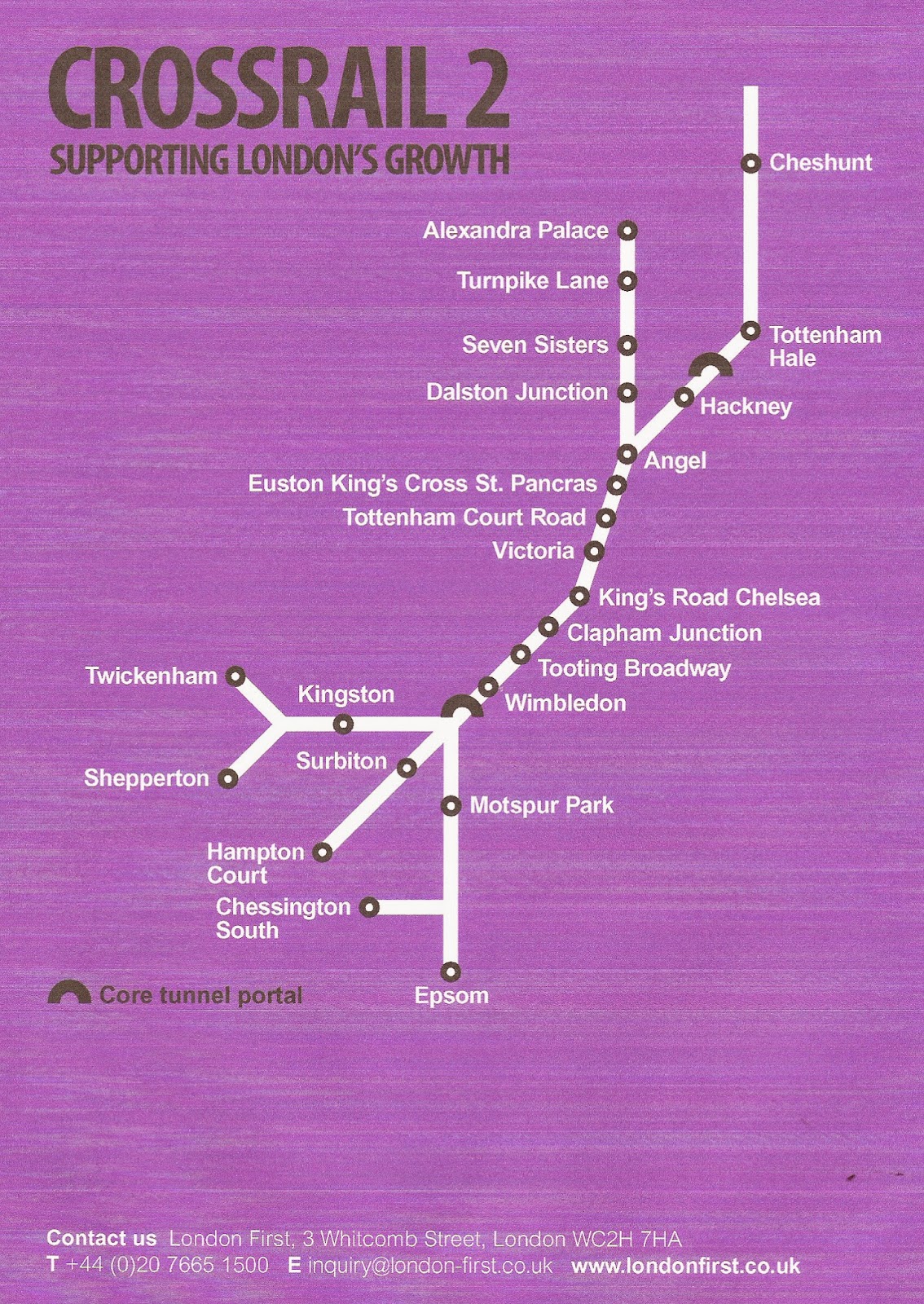
It all started with "London First´s" attempt to promote a cross London line from the South West to the North East of the City. This they have called Crossrail 2 which is really a misnomer since it mixes concepts even though most of the idea might well be positive.

We will look at this later in a clearer context.

It would be better to look at why these ideas about cross London rail connections are now flourishing. From that we can see why these ideas should be focused and what such focussing can provide us with.

Let us begin with why there is a desire to provide cross London Rail services.
The London Underground lines (LUL) go across town over a network developed over 150 years. There was no great plan and so we have what we have. We can live with this network, or fix it, or develop it inside or outside the limitations it has given us.

The National Rail network developed for differing reasons, mostly providing (what came to be known as)regional and inter-city services. The exceptions here were the commuter services (pricinpally south of the Thames) mixed in with the other services. Basically these were provided where there was a lack of LUL services.

From 1948  British Railways became the nationalised body in the UK to run the railways. In the south-east these were still grouped around the four original companies (which became the regions) of Western, London Midland, North Eastern and Southern. Much later the regional and commuter services were organised into Network South East.

Thereafter, from the 1980s and 1990s the government policy was of privatisation of the transport system which resulted, after several ups and downs, into the system we know today in 2014.

Faced with an upsurge in demand for rail services, which have not seen such passenger demand since the 1920s, based on experiences in the last ten years together with forecasts of a growing population for London of 1.000.000 over the next 15-20 years, it is then obvious to see that pressures on the transport system are going to be tremendous.

 "What can be done?"
Obviously, a lot can be done but we have to be rational and work within reasonable parameters and manageable resourses.
From this we come to...
a)-more trains with greater frequency - this is the result of better operational use, reducing the interval between trains -- it comes down to improved signalling. 
b)-longer trains -- this is heavily dependent of the length of platforms at each station. Extension is possible but limitations apply.
c)-higher capacity trains -- double-decker trains are not a possibility on British rail lines but "walk-through" carriages are. The layout can be so improved as to increase the passenger carrying capacity - without any impediment from one articulated carriage to another then capacity can be increased substantially.That is what has been done on the new trains for the Circle Line
http://www.globalrailnews.com/2013/09/03/s-stock-trains-take-to-circle-line/ and will be done on other lines.

After that we come to basic operational details. Any train stopping at a platform on a through station will remain to offload and load its passengers in a short time. These permit the train to enter and exit the station in an extremely short period so that it can be on its way in, even, under one minute. That permits the time difference between trains on lines through London being in the region of two-three minutes at rush hours. At least the north-south Thameslink through Farringdon and Blackfriars, as well as Crossrail aim to offer 24 trains per hour in each direction.

That is fine for through stations but when it comes to termini the situation changes. The Thames Valley commuting trains into Paddington and the commuter trains into Liverpool Street are the ones which will provide the traffic for Crossrail when it comes into service in 2018. These trains, at present, arrive at each terminus and stay for far longer than two-three minutes. They occupy space and time at each terminus. This is where time can be saved and frequency increased by putting them on to Crossrail. Eliminating these commuter services from the termini permits greater use of the platform space for more regional and long distance trains. This is where great gains can be made. The introduction of Crossrail in 2018 is estimated to provide an increase in total London commuter capacity of 10% - a substantial increase.

Having understood this we can then look at the problem of commuter services entering and terminating at mainline stations in London and how they can be taken out of the termini to provide services through Central London.

A second problem raises its head, however. Almost all the commuter services are run with electric traction. All London Underground(LUL) and almost all London Overground(LOL) services are run on the three rail system - drawing electric current for traction from a third rail. The old Southern Region of British Rail - basically all the services south of the Thames - also uses the third rail for electric traction. These services these days are offered by, mostly, South West Trains, Southern and Southeastern.

North of the Thames most services are electric but using overhead wires for collection of the current. This is true for commuter services out of Paddington, Euston, St.Pancras, Kings Cross, Moorgate, Liverpool St. and Fenchurch St. The exception here are the Chiltern Trains services out of Marylebone. At the moment they are run with diesels so it is not a question of if, but when these lines are electrified they will be to overhead electric transmission.

From that if we wish to link commuter services to commuter services, as will be done with Crossrail, then we have to think of compatibility and cost. This brings us to the conclusion of "like with like", as much as possible. Thameslink is the exception since it operates both north and south of the Thames. This is not an ideal solution because the trains which travel to both sides of the river have to be compatible with both systems,third rail and overhead, resulting in more complex and more expensive vehicles.However, a lot can be done with thought.


1)-   Crossrail A: I do not wish to use numbers since they could lead to confusion about what I want to say. For that reason the original Crossrail I will call Crossrail A. This is the line which runs from Reading and Heathrow Airport in the west to Shenfield and Abbey Wood in the east. It involves electrification of quite a part of the line with some new construction down to Abbey Wood and tunnels through Central London which are about 21kms in length each way. In the east there has been speculation about extending the line from Abbey Wood to connect to HS1 at Ebbsfleet - a logical and inevitable event. From Shenfield the extension can be made from there to Southminster and Southend Victoria taking over the said part of the Greater Anglia services into Liverpool St.

In the west we find that 14 of the 24 trains per hour will stop at Paddington. To rectify this misuse of resources there has been a proposal to feed on to Crossrail some of the commuter services from Tring, or even from Milton Keynes, that presently run into Euston(London Midland services) from the WCML. To this blogger that sounds like a badly thought out quick-fix.Thus I offer an alternative.
The Great Western services between West Ealing and Greenford are intended to be run as a diesel shuttle service. This blogger proposes that Crossrail A services run along that line to Greenford and on to West Ruislip.They would thus take over the LUL Central Line services to West Ruislip so that the Central line would terminate at Greenford.This would entail lengthening of the platforms at each station and conversion of the system to overhead electric wires. This will not seem such a wild idea when I mention Crossrail B.
The interchange at West Ruislip would be between Crossrail A , Chiltern Line trains and even HS2.
 
--------------------------------------------------------------------------------

 2)-   Crossrail B:  If we take it as a logical progression from policies applied north of the Thames regarding electrification of rail services, then it is safe to say that when electrification comes to the Chiltern Lines from Marylebone station then they will be converted to overhead operation. 
From that we can associate the Chiltern Line commuter services from Marylebone with  existing commuter services to Amersham and Aylesbury Vale Parkway plus those to High Wycombe and Aylesbury, plus the London Midland services to Tring and Milton Keynes along the WCML. These run roughly parallel so are complementary.

At the other end of central London we have the Essex Thameside line operated by C2C from Fenchurch St. The London Midland and the C2C services (and it is supposed the Chiltern services eventually) are operated by overhead electrical supply. Join the two sides with a tunnel from Fenchurch St. - Cannon St. - Blackfriars - Aldwych (more to be said later) - Tottenham Court Rd.- New Cavendish St./Portland Place(new station) - Marylebone (and Baker St.). From Marylebone one branch would continue to South Hampstead and West Hampstead to continue on the Chiltern Lines to the north west, while a second branch would connect Marylebone with Queens Park and on to the WCML out to Watford Junction etc.

The lines at both ends would need no special conversion as they are overhead wires. The inevitable electrification of the Chiltern lines would be brought forward but that is only a question of when not if. The tunneling from Fenchurch St. to Marylebone and onwards would come to about 13.3kms. which compares quite favourably with Crossrail A where the tunneling has come to be about 21kms. in each direction.

Are the services compatible? If we look at the periods of 06.30 to 10.00hrs for those services into the London termini, and from the termini between 16.30 and 20.00hrs. we can see that C2C runs 48/49 into and out of Fenchurch St. while London Midland (into / out of Euston) plus Chiltern Trains (into / out of Marylebone) run in total the same number of services - 48/49. That makes for a rate of 14 tph at each end. However, if we understand that joining the lines would mean there were no platform dwelling time at the termini we can see that a capacity increase is built into the system ready to be exploited.

One line which could be used, at least in part, is the now closed Post Office Railway which runs from Paddington to Whitechapel. This would save a large amount of expense on tunelling.

As a result a valuable piece of real estate at Fenchurch St. would be freed up for development to help pay for the scheme.


------------------------------------------------------------------------------------------


3)-   Because of this solution we are now presented with an opportunity. The Metropolitan lines from Amersham, Chesham, Watford Junction (soon to be completed) and Uxbridge run into Baker St. for most of the day. At the rush hours these trains run along the Circle Line to Aldgate to serve commuters into/out of the City. The potential of this line is, therefore, underused. With the "Crossrail B" services running across town to serve the City and onwards The Metropolitan Line does not need to serve the City but can be put to other uses.

An overlooked gap in the central London LUL map now has the opportunity to be filled.
The Metropolitan line can now run  Baker St. - Marble Arch - Hyde Park Corner - Victoria - Kennington. From there it would continue south to - John Ruskin St.(new station) - Camberwell New Rd. (new station) - Denmark Hill - North Dulwich - West Dulwich - Sydenham Hill - Gipsy Hill - Crystal Palace. One line would then branch off to Beckenham Junction while the other would go to Purley then divide to Tattenham Corner and Caterham. These inner London services would thus pass to TfL following the policies of London´s mayor that all such services should be under TfL.


------------------------------------------------------------------------

4)-   Once we look at the Metropolitan Line services from the north west suburbs then we have to look at the LUL Bakerloo Line. This, at present, runs from  Harrow & Wealdstone to the Elephant & Castle, south of Waterloo.Any extension northwards of this line would be up to Watford Junction coinciding on that section with the services into Euston of Overground. 

However, there is a proposal on the table from Transport for London(TfL) to extend this line to underserved areas south of the Thames. "Proposed Bakerloo line extension route considered", (Global Rail News 30-9-14) and (Evening Standard 20-10-14)"Government funds may not be needed for £3bm Bakerloo Line extension,"


There are a couple of things to point out. The southern extension only provides one new station at Camberwell connecting to the existing station at Peckham Rye, while the northern extension to New Cross Gate provides two new stations (provisionally named Old Kent Rd. 1&2) in this underserved area of South London. This blogger thus supports the northern option as being more beneficial especially since a Camberwell station can be built in the Metropolitan Line project.
The other point to mention is that there is a reference to an extension to Bromley town centre. This has since proved to be the the extension of the branch through Beckenham Junction to Bromley South. On the other hand there is a branch from Grove Park to Bromley North. This, at the moment, is stuck out on a limb. However, if the previously existing services from Lewisham to Grove Park were reinstated to go along this branch then we have another option for the whole Bakerloo line.

It is pointed out that the branch to Hayes would take over all the National Rail services along that line. Any extension to Bromley South might take over, at least, some of the services from Victoria to Orpington. That, however, has to be explained in more detail. The Bromley North branch runs 3 tph thoughout the day. To provide a metro service a minimum of 4 tph is considered necessary. With a Bakerloo branch running through Lewisham direct to Bromley North that is quite feasible , if train paths are available. On the other hand there exists the idea of extending the services from Beckenham Junction to Shortlands or Bromley South and then with a new section of line to join up to Bromley North and on to Grove Park. These services would substitute the services through Lewisham to Bromley North and , therefore, not then interfer with the mainline ones through Lewisham and Hither Green down to Sevenoaks.

----------------------------------------------------------------------------------

5)-   Once we mention any Bakerloo line extension we have to look at the Overground(LOL) service from Watford Junction to Euston. The Overground service is basically a cross London service to circle the capital. This has been the development so far, very successfully. 
The Overground services terminating into Euston, therefore, have no logic. 
If we look at the Overground map we can see that there is just a short break between South Hampstead and Camden Rd. The distance is 2.8kms over an already existing line between the two stations but really comes down to a connection of only 800 meters on lines which already exist. It does not suppose any new construction so can be accomodated very easily. From there the Watford line can be connected, in two stops, to the line at Highbury & Islington  from which services can be forwarded on to New Cross, Crystal Palace, West Croydon, and Clapham Junction without any difficulty.

There was a proposal to extend the Overground services from New Cross southwards to Lewisham. This is only possible with works at New Cross. Where the present lines diverges from Surrey Quays to New Cross it becomes a one way line which then runs into New Cross without any connection to the other lines through the station, into a turnback facility with one platform. Substantial works would be necessary to be able to extend the line southwards to Lewisham which are most likely not cost effective. For that reason the Overground services from Watford Junction could run into New Cross,into New Cross Gate and on to West Croydon, Crystal Palace and Clapham Junction as the present services do. 
T

These Overground services from Watford Junction, being diverted along the line through Camden Road and  Highbury & Islington will only mean the loss of Euston as a station. That is beneficial as it will free up much needed platform space and can be easily covered by the services on the Bakerloo line plus the improved services on Crossrail B.


--------------------------------------------------------- 


6-)  The Cockfosters Line:
The Piccadilly (LUL) Line runs from Heathrow and Uxbridge to Cockfosters. From the west after Leicester Square and Covent Garden the line turns north to Holborn, Kings Cross, Finsbury Park and Cockfosters.
However, from Holborn, there still exists a branch(now closed) to Aldwych (closed). If there were a will then the Cockfosters branch could run south to Holborn, then Aldwych and southwards under the Thames.
The logical extension would be to Temple (Circle/District lines) - Waterloo/Waterloo East - Elephant & Castle - Camberwell(a new station as indicated before) - Loughborough Junction - (and stations to)  - Tulse Hill - Streatham Common - Mitcham Junction - Sutton and Epsom Downs. Obviously this line would include the loop through Tooting, Wimbledon and Sutton (at present operated by Thameslink).


-----------------------------------------------------------

7-)  With this operation the Piccadilly Line would be truncated at Holborn. However, other proposals in the past (like the abandoned Fleet Line project) have looked at the idea of aleviating the crowded Central Line. This has meant, for example, taking over the Central Line services from Leytonstone to Gants Hill and Hainault. If we extend this Piccadilly line services through Leyton Midland Rd. - Hackney Central, it can connect to the Chingford Line services through St. James Street to Hackney Central. The Line could then go south through (e.g.) London Fields - Haggerston - Essex Rd. - Angel - Clerkenwell(new station) to Holborn and onwards.That way we would have the Central Line aleviated while the Chingford Line, which will be taken over in 2015 by Overground, giving up its terminus and platforms at Liverpool St. while obtaining  useful cross-London destinations.

Tunelling would be needed from Holborn to Hackney Central which is about 6.4kms each way. Add to this tunelling from Hackney Central to below St.James St and Leyton Midland Rd. which could come in total to 6.2kms. each way. The service to Chingford would need to be changed to the third rail system but that to Hainault would need no change.

This is how the map would look like with these two lines.


-------------------------------------------------------------------------------------


That leaves the "London First" proposal for the so-called Crossrail 2 project. It is also known as  the Chelsea- Hackney line, or in short the Chelney Line. That is how I prefer to refer to it as will be seen.

 As said in the report as prepared by London First..........
The new line, Crossrail 2, would transform journeysfor commuters from the south-west and the north-east, including Wimbledon, Kingston,  Hackney, Islington, Tottenham, Cheshunt and Hertford East. It would also provide essential relief to major London interchanges, including Euston, Victoria and Clapham Junction, and reduce pressure on congested Tube lines. In some cases, journey times would be more than halved.

8)-The Chelney Line:
The general direction of the line has been laid down for some years. At first it was a southwest - northeast line to cover areas, such as Chelsea and Hackney which were lacking in Underground coverage.
Now, however, we have to be more specific.
i)- The Greater Anglia lines from Cheshunt and Enfield through Seven Sisters  are to be taken over by London Overground, together with the services from Chingford, into Liverpool St. in 2015.
These services can be taken out from Liverpool St., thus freeing up platforms,  and fed under the City to form part of the Chelney Line.
ii)- I disagree with London First in that these lines should go through Tottenham Hale. I would prefer to send out the Greater Anglia services from Liverpool St. to Hertford East, Stansted and Cambridge through Stratford. The Stansted Express as well as other local stopping services can call at Stratford to provide the necessary connections. By not calling at Tottenham Hale the Victoria line will not have the connections envisaged and so will not be provided with transfer passengers to an already overcrowded line, these will then be funelled on  to the Circle Line.
iii)-The extension to Alexandra Palace and even New Southgate can be taken on from London First´s suggestion, however, I would run the line from Seven Sisters.That way the inner core could have greater frequencies of trains while reducing the construction costs.
iv)-In the inner core the number of stations and their location can be taken from London First´s plan. However, north from Kings Cross this blogger suggests stations at Essex Rd., Haggerston, London Fields to connect to Hackney Central.
v)-At the southern end of the line there would be branches to Shepperton, Hampton Court and Chessington South. These would take over the South West Trains lines to those destinations thus freeing up platform space at Waterloo.

vi)-There is a suggestion to run a service through Kingston, Teddington, Strawberry Hill to Twickenham. That, however, has its difficulties as a new flyover would have to be constructed at Twickenham into a turnback facility which does not exist - certainly an expensive option.
vii)-There is also a suggestion to run trains from Wimbledon and Raynes Park through Motspur Park and Stoneleigh to Epsom. The practicality of this would depend on other services from Victoria and Waterloo to outlying areas.


The platforms saved from surburban trains at Paddington, Marylebone, Euston, 
Liverpool St., Victoria, Waterloo provide for a broad scope to increase regional and inter-city 
trains. That way the capacity, connections and convenience of the system can do much for the 
crushed commuter.

The London rail system, though mature, still can provide a flexibility to offer a greater variety of 
services along its lines. It only needs some broad thinking and political will to increase the 
capacity so as to satisfy the demands to made upon it it in the latter part of the 21st Century.


To read more on this subject look at the blog of London Reconnections for 24th October 2014.
   
Other bloggs, I have written,  related to this subject are.....
http://trans-trax.blogspot.com.es/2013/05/getting-lines-crossed-in-london.html
http://trans-trax.blogspot.com.es/2010/05/crossrail-where-is-it-going.html


06 April 2014

Is London as a transport hub holding us back? - The Solutions

The London Transport Hub is a reality with all its advantages and disadvantages. The problem is how far can it go on doing the same? Are there not physical limits to expansion especially when the conurbation is growing by thousands of persons per year?

I begin this second part by repeating the same questions as I finished the first.
Measures are being taken but are they enough? 
What is being done?
What can be done? 
Are there alternatives?


WHAT IS BEING DONE:
Quite frankly a lot is being done.


THAMESLINK:  The first attempt in modern times to redistribute the traffic flows so that the terminal stations and the metropolitan transport system did not become clogged up was with the reopening of the cross Thames link from Kings Cross/ St.Pancras to Farringdon then Blackfriars to the three rail system south  of the Thames. This originally opened in January 1866 and continued in use until  the end of the 1960s, though not all the time for passenger traffic. From 1988 the tracks were relaid and opened to north-south passenger traffic yet again.

Subsequently, this permitted a renewed connection between north and south of theThames which became very successful. This led to the Thameslink 2000 project which meant connecting lines from the north to the south of the Thames so  as to provide greater connectivity. The star example is the service from Bedford to Brighton (passing Gatwick and Luton airports).

Such was the case that the whole north-south connection was looked at. Now the whole question of franchises both north and south of the Thames is being modified.  The greatest example of this is the proposal from the DfT to merge the present Thameslink services with the Southern(South Central) and Great Northern  franchises.The new combined franchise would start from September 2014.

As can be seen at the end (annex F) of that DfT document the proposed traffic pattern includes north- south Thames´ services as well as those which terminate at Victoria, London Bridge and Kings Cross and Moorgate.This is a reversal of the previous policy whereby Thameslink was a cross river operator and the said terminals were devoted to a specific operator. Will not the same problems as before arise again to make the desirability of reducing the number of operators at a station a necessity? 
http://www.thameslinkprogramme.co.uk/


CROSSRAIL:The next attempt to aleviate the flows of passengers into London was the Crossrail scheme. This envisaged a cross conurbation rail service from (now) Reading and Heathrow (in the West), to Shenfield and Abbey Wood (in the East). 
In gross terms this service would take the surburban Great Western rail services from Paddington together with the Heathrow Connect services and connect them to the surburban rail services of Great Eastern from Liverpool Street to Shenfield (Essex) while also providing an extension to Abbey Wood in Kent to connect to South Eastern services.

The net result of this line would be to provide greater access to Central London from the surburbs thus freeing up Underground places from the main line termini, while also freeing up platform space at these termini to facilitate more long distances inter-city rail services. The estimates are that this new Crossrail service will increase London´s transport capacity by 10% - a substantial figure.

Crossrail (and Thameslink) are planned to extract numbers from the central Underground areas but will provoke problems of their own. The latest study from Arup(20 January 2014) The passenger numbers expected to embark/disembark at the central stations of Bond Street, Tottenham Court Road and Farringdon have increased from the  estimate made in 2004 of 185 million per annum to a revised figure now for 2026 of 250 million per annum - a massive increase of 35%.
http://www.crossrail.co.uk/


TUBE IMPROVEMENT:
Another area where Transport for London (TfL) - the governing body for all London transport - decided major improvements could be made was to make up for the lack of investment in the capital´s transport system - particularly the Undergound (Tube) - over many decades.
The focus has been on three main areas:
--- Upgrade the antiquated signalling system:  this ensures greater reliabilty and thus fewer breakdowns - also it permits a shorter time limit between trains and thus increases the frequency per hour of the number of trains, therefore increasing capacity.
--- Increase in the length of trains (where possible) thus increasing capacity.
--- improve the configuration of the trains so that they can accelerate and decelerate more quickly, while also eliminating the barriers between carriages thus increasing the capacity (walk-through carriages).
Bettering the travel experience with improved facilities, especially for the less mobile,and safety are also part of the process.
These measures require time to be put in place but TfL is undertaking the process. The improvement will be substantial again but the question is how far can these measures solve the problems. 
http://www.tfl.gov.uk/travel-information/improvements-and-projects/tube-improvement?intcmp=11481

With the expected increase in population (at 200+ persons per day) in the capital and the South East in general there will be a limit to how much the present system can be improved (the law of diminishing returns). But where is the limit?


WHAT CAN BE DONE:

OTHER MEASURES TO BE TAKEN:

Greater Anglia: While the above mentioned improvements are going on TfL and National Rail are proposing additional solutions. 
Firstly, London´s Mayor, Boris Johnson wants to include all rail services within the London boundaries (basically inside the M25 circular motorway) into the remit of TfL. The benefits of this move are not clear - they seem to be more a case of empire building by Boris.


The first step he has achieved is to ensure that the responsibility for the Greater Anglia commuter services from Liverpool Street to Chingford, Enfield Town and Cheshunt  pass to TfL. They might well be branded Overground though these services are fed by overhead electric lines and not the third rail, as the other Overground services are. The stations will be upgraded to TfL standards. If the results achieved by Overground, with improved facilities and safety measures, can be used as a model then the usage of these services will increase substantially.

It should be mentioned here that that the original idea of the Overground scheme was to join
together all the bits and pieces of the British Rail system round Greater London which were not connected. This lead to the idea of connecting them as a circular rail system to connect the middle and outer surburbs on Greater London. It proved successful and so the Mayor, Boris Johnson, has been encouraged to expand it. The motivational idea was "Connectivity" (which this blogger supports wholeheartedly)as well as "capacity". Connecting the outer limits of the transport system means fewer numbers of passengers have to travel through the centre but use the outer connections - something to be encouraged. 


Crossrail 2:The second step is more in the long-term. Crossrail 2, used initially as a working title, is a proposal to run rail services from South West London out to the North East. It was
originally called the Chelsea-Hackney (Chelney) line as a new line of the Underground. 
It has lately been pushed by a grouping of businessmen and politicians called London First led by the ex-transport minister Lord Adonis. The London Mayor, Boris Johnson, has taken the idea on board fully.
 
There are two options being studied at the moment. (a) Metro option: this would be a LUL line from Wimbledon  through Kings Road Chelsea to Victoria then Euston/Kings Cross and on to Alexandra Palace (with other intermediate stops).  
(b) Regional option: this would run further south and further north, connecting some South West Trains´ services from Shepperton, Hampton Court and Chessington South(or even elsewhere) to the line at Wimbledon while at the northern end the lines to be connected could be the aforementioned Greater Anglia lines to Chingford, Enfield Town and Cheshunt (or others).
The real problem would be the two differing electric systems used (a) the third rail 750 DC used on the commuter network south of the Thames while north of the river (b) the overhead gantry system of 25Kv AC is used. This has already been solved with the Thameslink network both north and south so it is not insuperable - expensive it is, but workable.
The whole process is at an early stage so nothing definite has been decided yet.


LUL extensions:  There are some tweaks to the system which have already been approved. One involves the long waited for extension of the Metropolitan Line from Croxley to Watford Junction. Another is the approved Northern Line extension from Kennington to Nine Elms and Battersea.

In fact this blogger has already set out his ideas for improvements to the rail systems in London in his blog of 25 May 2013 titled "Getting the lines crossed in London - Crossrail 1 & 2 & other lines.
I repeat some of them here.
(a) - the separation of the Charing Cross and City branches of the Northern Line (LUL) into two separate lines, one going to Battersea and the other to Morden. 
(b) Extension of the Northern Line from Morden to Morden South(to connect with the National Rail line).
(c) - better use of the Waterloo and City Line (extensions to Clapham Junction and Stratford?? - with intermediate stops)
(d) - Hammersmith & City Line extension to Barnes (to connect to South West trains)
(e) - Metropolitan Lines extended throughout the day through central London from Baker St.
(f) - The extension of the Northern Line branch from Mill Hill East to Mill Hill Broadway, Edgware and Stanmore ( to connect to the other lines at those stations thus providing better connections across the suburbs).
All of these mean extensions of existing lines which are not particularly complicated.


However, the following ideas mean using part of the south Thames rail network to add to the extensions.
(g)- extension of the Bakerloo Line to other areas south of the Thames where there are large gaps in the commuter network. Onwards to Peckham Rye (with intermediate new stops)and Lewisham with one set continuing on the circular lines through Woolwich Arsenal, Slade Green and Eltham (and viceversa). The other part would go along the circular lines through Hither Green, Crayford, Bexleyheath and Eltham (and vice versa), to return through Lewisham to Peckam Rye etc.
(h) - The Piccadilly Line split at Holborn so that the Cockfosters branch can be extended to Aldwych, Temple and areas south of the Thames where the Undergound is under-represented. Down to the Elephant & Castle, and on to the Sutton, Wimbledon loop on one side while to Caterham and Tattenham Corner on the other.
(j)The Heathrow and Uxbridge Piccadilly branches would continue from Holborn out north-eastwards(serving areas of Hackney and the Chingford Line, and perhaps taking over parts of the Central Line at the end).
That way a sizeable part of the commuter network would be brought into the LUL system giving the Underground a greater visibility south of the Thames. A net result could be aleviating the pressure on the platforms at Victoria, Charing Cross, Blackfriars, London Bridge and Cannon St.


OVERGROUND: One service which is crying out for modification is the Overground line from Watford Junction to Euston. The subtraction of this line from Euston would free up  platforms for other badly needed services. The solution is simple. From South Hampstead the line can divert to Camden Road along a preexisting track and then continue to Highbury & Islington. Here it would connect to the Overground service to run to New Cross. At present the line finishes there on its easterly branch. However, the service can be extended to Lewisham and Hayes, and to Lewisham, Grove Park and Bromley North. These would result in being two extensions from New Cross, possibly saving platform space at the Cannon St. and/or Charing Cross termini.


AIRPORT EXPRESS SERVICES:The  Heathrow Express service could combine with the Stansted Express service to run on Crossrail tracks through Central London to link the two airports as a joint Heathrow-Stansted Express (thus freeing up platforms at Paddington and Liverpool St.). They would run to Stratford and then on to Stansted. There would be no need for a large number of passengers to change at Paddington and Liverpool St. thus freeing up LUL seats. Both services run at a frequency of 4 trains per hour.

REGIONAL SERVICES:  I also repeat the idea of combining the regional services from Milton Keynes (London Midland) and the Chiltern Line(from Aylesbury and High Wycombe) to those of C2C to Southend.The services running into Fenchurch St. along the Tilbury Line operated by C2C are a prime candidate. They are suburban and regional commuter lines with no connection to any other line or terminus (except for the occasional train running into Liverpool St.). The terminus occupies a prime site of real estate in the City of London. The station site could be sold while keeping the right to have access to the line at a station underground in the same place.

A tunnel would be excavated from Fenchurch St. to run under Central London with stops at Cannon St., Blackfriars, Aldwich(reopened), Tottenham Court Rd., New Cavendish St. (Portland Place)(a new station), Marylebone/Baker St. (connected to both). The tunnel would continue northwards with one branch passing through Maida Vale to emerge at Queens Park and joining the WCML to travel through Willesden Junction incorporating most or all of the London Midland services to Milton Keynes. Thus platforms would be freed up at Euston.

The second section of the tunnel would go directly northwards from Marlebone/Baker St. passing under South Hampstead and continuing to emerge at West Hampstead. The services would continue along the Chiltern Line through Wembley Park and Wembley Stadium on to Aylesbury and Aylesbury Vale Parkway via Amersham and High Wycombe respectively. These surburban and near regional lines would thus be diverted on to another Crossrail Line through London freeing up platform space at Marylebone station. 

The work needed to be done on these lines would be the electrification of these surburban Chiltern sections. That however, could be part of a general electrification of the Chiltern Line to Birmingham and Oxford which surely will be done in the mid-term. Both the C2C and the London Midland services use overhead power lines at 25Kv AC so the systems are compatible.

Cutting the cost of HS2:

Lords Bradshaw and Berkeley have been active in the House of Lords with different proposals to reduce the cost of the new High speed line HS2 and improve the connectivity of the regional WCML services into and through London.
"Peers and HS2 officials to discuss alternative ‘Euston Cross’ plan" (22-4-13 Rail Technology Magazine)
They have also proposed, quite sensibly in my opinion, dropping the HS1 - HS2 connection along the North London line.
"Peers put forward suggestions on London end of HS2" (7-3-14 Rail Technology Magazine)
This blogger welcomes the decision of the government to scrap the HS1 - HS2 connection.
"Government to scrap HS2 link with HS1" (25-3-14 Rail Technology Magazine)
The reasons given, though valid, are a bit vague - ".....its impact on freight, passengers and the community in Camden”.

The three articles are detailed so I will not go into them here. However, the main reason not mentioned for the cancellation of the HS1 - HS2 link is that  it is logistically a nightmare and thus is not viable. Great Britain is outside the Schengen agreement so it maintains its Border controls on all incomers to the country whether thay be from the European Union or elsewhere. this means that if HS trains were run from the provinces to mainland Europe then the passengers would (a) have to disembark at some point to pass Border controls thus eliminating the advantage of through HS services or (b) pass Border controls at the embarkation stations and be isolated from travellers not going to mainland Europe. This is precisely the problem facing Eurostar services being extended from Brussels to Amsterdam and Cologne(with intermediate stops). It is simpler, cheaper and much less of a headache to start all HS European(Eurostar or other) trains at St.Pancras. Yes, but not all.


Another idea floated was by the pressure group Greengauge 21  called 
(c) Greengauge 21 2014
"HS1 – HS2 connection:A way forward"(1-4-14)
It is an interesting but flawed document to read. It contains, for example, a detailed explanation of why direct HS2 services to Mainland Europe are so difficult to organise.
However, it reflects the ideas of its promoters when it should abandon some concepts about which Greengauge 21 itself has come to some clear conclusions. For example, it accepts the necessity of abandoning the HS1-HS2 connection through Camden then goes on to say that that is the way to connect services northwest to those southeast of the capital.
There is a shorter version of the same in "Rail Technology Magazine" (2-4-14) 
"Alternative HS1-HS2 link proposed"


OTHER, PERHAPS, MORE IMPORTANT IDEAS OUTSIDE LONDON:

What has to be looked at seriously, which has not been done as yet, are the possibilities of diverting traffic away from the centre of London completely. By this I do not mean local(London) or regional traffic which has already been mentioned.

SUGGESTION: Having said that there could be a solution. This would mean bypassing London with new different services.

Ideas have been floated about rail connections from (a)Reading to Heathrow and from (b) Heathrow to Gatwick. 
Connection (a) has now been approved."Heathrow rail link plan unveiled by Network Rail" (4-2-14 BBC News)
Connection (b) was mooted under the title "Heathwick" - to connect the terminals at both airports with a fast rail link so that they could work as one. This was plainly "pie in the sky" as it was proposed and has died its death.
However, this blogger did propose a combination of both. 
Reading - Heathrow Rail Connection (6-10-11) 
Heathrow - Gatwick Rail Link (11-10-11)

It takes no big mental effort to see that a connection from Gatwick airport to Ashford and into the Channel Tunnel is the next step. That would mean Reading, Heathrow and Gatwick would be interconnected and able to offer ongoing services - some to Continental Europe and others as regional services to northeast Kent. 
At Reading passengers would arrive from the Midlands, the west, South Wales and the South West, for airport and regional services without going through London.
At the airports passengers would not only be able to reach regional destinations without going through Central London, but also those ongoing to near European destinations such as Paris, Brussels, Amsterdam and Cologne could take pressure off the shorter European flights and perhaps reduce demand on them. Thus expansion at the airports would be controlled to a certain extent.   
To achieve this Eurostar and other international services could start at Reading.
Here dedicated platforms and Border controls could be provided  on trains that run through Heathrow (T5, Central & T4), on to Gatwick airport, then to Ashford and through the Channel Tunnel to Paris and Brussels, all on dedicated international trains. This is an idea I have floated before.


Both the international services and the regional services would eliminate the need to travel into Central London to reach the TWO major airports.This is a "win, win" situation: (a) alternatives to ongoing flights to Europe from the two airports at distances where rail is very competitive with air travel, and (b) greater connectivity (thus capacity) between the two major airports in the country to enable more rapid interconnection,  while(c)better connectivity for travellers, tourists, commuters and others who will not need to travel through Central London thus aleviating the TfL system.

This blogger has expounded these ideas before such as:
Long-haul rail terminals under Heathrow and Gatwick.(4-5-12)

It takes no great effort of the imagination to see the possibility of regional services over this line, which I call SHSL (Southern High Speed Line), from further afield. These places could be Birmingham and Oxford, Bath and Bristol, Cardiff and Swansea, and elsewhere. The possibilities opened up are numerable.


FREIGHT:
This has always been the poor relation of rail services because it does not transport people - commuters, businessmen/women, tourists, sports fans or whoever - only goods.

It has to be accepted that London is not a seaport any longer. The port facilities are further down towards the end of the Thames Estuary and even elsewhere. Whether the rail (or road) transport is going to Tilbury, Felixstowe, Dover or Southampton the principle should be accepted that none of these imports/exports should go through London unless they are destined to/from London itself. That is of vital importance to take rail traffic off London´s lines and lorries off its roads - and especially the M25.


Line initiatives for freight, such as the Southampton-Basingstoke-Reading line(and on to Nuneaton), and the Felixstowe-Nuneaton line are to be welcomed. but they are not enough. serious thought should go into the idea of taking lorries off the roads so that they avoid London and other cities and towns as much as possible.  

This blogger´s ideas on avoiding central London were expounded in more detail through the two following links. 
"Fast Trax 2 - The case for a southern high speed alternative (SHSL)" (24-2-10)
"Who wants the Irish....?"(15-5-12)

Those who have read the last link will realise that it refers to the transport of freight(more than passengers) between continental Europe and the Republic of Ireland through England and Wales. However, both go on to explain how the idea could be extended to regional pick up points for freight traffic near Bristol and near Birmingham. All of these would have the double benefit of diverting traffic from London, and taking lorries off the roads further from the Channel tunnel so that fewer fumes are emitted into our air.


What will it take to achieve all this? 
It needs the vision to see the future benetfits, the political will to put ideas into action and the economic commitment to fund a rolling programme to fulfill it. Money should be spent on beneficial projects to the greater good for the greater number. It does not necessarily have to make an economic case, a social one might well be sufficient. However, such action will always be better than grand vainglorious projects which become self seeking in the end in a prison of political commitment and face saving.