Showing posts with label rail electrification. Show all posts

31 October 2014

London´s Cross City rail lines, and more.


The last few weeks has seen some movement about the extension of rail services across London.

It all started with "London First´s" attempt to promote a cross London line from the South West to the North East of the City. This they have called Crossrail 2 which is really a misnomer since it mixes concepts even though most of the idea might well be positive.

We will look at this later in a clearer context.

It would be better to look at why these ideas about cross London rail connections are now flourishing. From that we can see why these ideas should be focused and what such focussing can provide us with.

Let us begin with why there is a desire to provide cross London Rail services.
The London Underground lines (LUL) go across town over a network developed over 150 years. There was no great plan and so we have what we have. We can live with this network, or fix it, or develop it inside or outside the limitations it has given us.

The National Rail network developed for differing reasons, mostly providing (what came to be known as)regional and inter-city services. The exceptions here were the commuter services (pricinpally south of the Thames) mixed in with the other services. Basically these were provided where there was a lack of LUL services.

From 1948  British Railways became the nationalised body in the UK to run the railways. In the south-east these were still grouped around the four original companies (which became the regions) of Western, London Midland, North Eastern and Southern. Much later the regional and commuter services were organised into Network South East.

Thereafter, from the 1980s and 1990s the government policy was of privatisation of the transport system which resulted, after several ups and downs, into the system we know today in 2014.

Faced with an upsurge in demand for rail services, which have not seen such passenger demand since the 1920s, based on experiences in the last ten years together with forecasts of a growing population for London of 1.000.000 over the next 15-20 years, it is then obvious to see that pressures on the transport system are going to be tremendous.

 "What can be done?"
Obviously, a lot can be done but we have to be rational and work within reasonable parameters and manageable resourses.
From this we come to...
a)-more trains with greater frequency - this is the result of better operational use, reducing the interval between trains -- it comes down to improved signalling. 
b)-longer trains -- this is heavily dependent of the length of platforms at each station. Extension is possible but limitations apply.
c)-higher capacity trains -- double-decker trains are not a possibility on British rail lines but "walk-through" carriages are. The layout can be so improved as to increase the passenger carrying capacity - without any impediment from one articulated carriage to another then capacity can be increased substantially.That is what has been done on the new trains for the Circle Line
http://www.globalrailnews.com/2013/09/03/s-stock-trains-take-to-circle-line/ and will be done on other lines.

After that we come to basic operational details. Any train stopping at a platform on a through station will remain to offload and load its passengers in a short time. These permit the train to enter and exit the station in an extremely short period so that it can be on its way in, even, under one minute. That permits the time difference between trains on lines through London being in the region of two-three minutes at rush hours. At least the north-south Thameslink through Farringdon and Blackfriars, as well as Crossrail aim to offer 24 trains per hour in each direction.

That is fine for through stations but when it comes to termini the situation changes. The Thames Valley commuting trains into Paddington and the commuter trains into Liverpool Street are the ones which will provide the traffic for Crossrail when it comes into service in 2018. These trains, at present, arrive at each terminus and stay for far longer than two-three minutes. They occupy space and time at each terminus. This is where time can be saved and frequency increased by putting them on to Crossrail. Eliminating these commuter services from the termini permits greater use of the platform space for more regional and long distance trains. This is where great gains can be made. The introduction of Crossrail in 2018 is estimated to provide an increase in total London commuter capacity of 10% - a substantial increase.

Having understood this we can then look at the problem of commuter services entering and terminating at mainline stations in London and how they can be taken out of the termini to provide services through Central London.

A second problem raises its head, however. Almost all the commuter services are run with electric traction. All London Underground(LUL) and almost all London Overground(LOL) services are run on the three rail system - drawing electric current for traction from a third rail. The old Southern Region of British Rail - basically all the services south of the Thames - also uses the third rail for electric traction. These services these days are offered by, mostly, South West Trains, Southern and Southeastern.

North of the Thames most services are electric but using overhead wires for collection of the current. This is true for commuter services out of Paddington, Euston, St.Pancras, Kings Cross, Moorgate, Liverpool St. and Fenchurch St. The exception here are the Chiltern Trains services out of Marylebone. At the moment they are run with diesels so it is not a question of if, but when these lines are electrified they will be to overhead electric transmission.

From that if we wish to link commuter services to commuter services, as will be done with Crossrail, then we have to think of compatibility and cost. This brings us to the conclusion of "like with like", as much as possible. Thameslink is the exception since it operates both north and south of the Thames. This is not an ideal solution because the trains which travel to both sides of the river have to be compatible with both systems,third rail and overhead, resulting in more complex and more expensive vehicles.However, a lot can be done with thought.


1)-   Crossrail A: I do not wish to use numbers since they could lead to confusion about what I want to say. For that reason the original Crossrail I will call Crossrail A. This is the line which runs from Reading and Heathrow Airport in the west to Shenfield and Abbey Wood in the east. It involves electrification of quite a part of the line with some new construction down to Abbey Wood and tunnels through Central London which are about 21kms in length each way. In the east there has been speculation about extending the line from Abbey Wood to connect to HS1 at Ebbsfleet - a logical and inevitable event. From Shenfield the extension can be made from there to Southminster and Southend Victoria taking over the said part of the Greater Anglia services into Liverpool St.

In the west we find that 14 of the 24 trains per hour will stop at Paddington. To rectify this misuse of resources there has been a proposal to feed on to Crossrail some of the commuter services from Tring, or even from Milton Keynes, that presently run into Euston(London Midland services) from the WCML. To this blogger that sounds like a badly thought out quick-fix.Thus I offer an alternative.
The Great Western services between West Ealing and Greenford are intended to be run as a diesel shuttle service. This blogger proposes that Crossrail A services run along that line to Greenford and on to West Ruislip.They would thus take over the LUL Central Line services to West Ruislip so that the Central line would terminate at Greenford.This would entail lengthening of the platforms at each station and conversion of the system to overhead electric wires. This will not seem such a wild idea when I mention Crossrail B.
The interchange at West Ruislip would be between Crossrail A , Chiltern Line trains and even HS2.
 
--------------------------------------------------------------------------------

 2)-   Crossrail B:  If we take it as a logical progression from policies applied north of the Thames regarding electrification of rail services, then it is safe to say that when electrification comes to the Chiltern Lines from Marylebone station then they will be converted to overhead operation. 
From that we can associate the Chiltern Line commuter services from Marylebone with  existing commuter services to Amersham and Aylesbury Vale Parkway plus those to High Wycombe and Aylesbury, plus the London Midland services to Tring and Milton Keynes along the WCML. These run roughly parallel so are complementary.

At the other end of central London we have the Essex Thameside line operated by C2C from Fenchurch St. The London Midland and the C2C services (and it is supposed the Chiltern services eventually) are operated by overhead electrical supply. Join the two sides with a tunnel from Fenchurch St. - Cannon St. - Blackfriars - Aldwych (more to be said later) - Tottenham Court Rd.- New Cavendish St./Portland Place(new station) - Marylebone (and Baker St.). From Marylebone one branch would continue to South Hampstead and West Hampstead to continue on the Chiltern Lines to the north west, while a second branch would connect Marylebone with Queens Park and on to the WCML out to Watford Junction etc.

The lines at both ends would need no special conversion as they are overhead wires. The inevitable electrification of the Chiltern lines would be brought forward but that is only a question of when not if. The tunneling from Fenchurch St. to Marylebone and onwards would come to about 13.3kms. which compares quite favourably with Crossrail A where the tunneling has come to be about 21kms. in each direction.

Are the services compatible? If we look at the periods of 06.30 to 10.00hrs for those services into the London termini, and from the termini between 16.30 and 20.00hrs. we can see that C2C runs 48/49 into and out of Fenchurch St. while London Midland (into / out of Euston) plus Chiltern Trains (into / out of Marylebone) run in total the same number of services - 48/49. That makes for a rate of 14 tph at each end. However, if we understand that joining the lines would mean there were no platform dwelling time at the termini we can see that a capacity increase is built into the system ready to be exploited.

One line which could be used, at least in part, is the now closed Post Office Railway which runs from Paddington to Whitechapel. This would save a large amount of expense on tunelling.

As a result a valuable piece of real estate at Fenchurch St. would be freed up for development to help pay for the scheme.


------------------------------------------------------------------------------------------


3)-   Because of this solution we are now presented with an opportunity. The Metropolitan lines from Amersham, Chesham, Watford Junction (soon to be completed) and Uxbridge run into Baker St. for most of the day. At the rush hours these trains run along the Circle Line to Aldgate to serve commuters into/out of the City. The potential of this line is, therefore, underused. With the "Crossrail B" services running across town to serve the City and onwards The Metropolitan Line does not need to serve the City but can be put to other uses.

An overlooked gap in the central London LUL map now has the opportunity to be filled.
The Metropolitan line can now run  Baker St. - Marble Arch - Hyde Park Corner - Victoria - Kennington. From there it would continue south to - John Ruskin St.(new station) - Camberwell New Rd. (new station) - Denmark Hill - North Dulwich - West Dulwich - Sydenham Hill - Gipsy Hill - Crystal Palace. One line would then branch off to Beckenham Junction while the other would go to Purley then divide to Tattenham Corner and Caterham. These inner London services would thus pass to TfL following the policies of London´s mayor that all such services should be under TfL.


------------------------------------------------------------------------

4)-   Once we look at the Metropolitan Line services from the north west suburbs then we have to look at the LUL Bakerloo Line. This, at present, runs from  Harrow & Wealdstone to the Elephant & Castle, south of Waterloo.Any extension northwards of this line would be up to Watford Junction coinciding on that section with the services into Euston of Overground. 

However, there is a proposal on the table from Transport for London(TfL) to extend this line to underserved areas south of the Thames. "Proposed Bakerloo line extension route considered", (Global Rail News 30-9-14) and (Evening Standard 20-10-14)"Government funds may not be needed for £3bm Bakerloo Line extension,"


There are a couple of things to point out. The southern extension only provides one new station at Camberwell connecting to the existing station at Peckham Rye, while the northern extension to New Cross Gate provides two new stations (provisionally named Old Kent Rd. 1&2) in this underserved area of South London. This blogger thus supports the northern option as being more beneficial especially since a Camberwell station can be built in the Metropolitan Line project.
The other point to mention is that there is a reference to an extension to Bromley town centre. This has since proved to be the the extension of the branch through Beckenham Junction to Bromley South. On the other hand there is a branch from Grove Park to Bromley North. This, at the moment, is stuck out on a limb. However, if the previously existing services from Lewisham to Grove Park were reinstated to go along this branch then we have another option for the whole Bakerloo line.

It is pointed out that the branch to Hayes would take over all the National Rail services along that line. Any extension to Bromley South might take over, at least, some of the services from Victoria to Orpington. That, however, has to be explained in more detail. The Bromley North branch runs 3 tph thoughout the day. To provide a metro service a minimum of 4 tph is considered necessary. With a Bakerloo branch running through Lewisham direct to Bromley North that is quite feasible , if train paths are available. On the other hand there exists the idea of extending the services from Beckenham Junction to Shortlands or Bromley South and then with a new section of line to join up to Bromley North and on to Grove Park. These services would substitute the services through Lewisham to Bromley North and , therefore, not then interfer with the mainline ones through Lewisham and Hither Green down to Sevenoaks.

----------------------------------------------------------------------------------

5)-   Once we mention any Bakerloo line extension we have to look at the Overground(LOL) service from Watford Junction to Euston. The Overground service is basically a cross London service to circle the capital. This has been the development so far, very successfully. 
The Overground services terminating into Euston, therefore, have no logic. 
If we look at the Overground map we can see that there is just a short break between South Hampstead and Camden Rd. The distance is 2.8kms over an already existing line between the two stations but really comes down to a connection of only 800 meters on lines which already exist. It does not suppose any new construction so can be accomodated very easily. From there the Watford line can be connected, in two stops, to the line at Highbury & Islington  from which services can be forwarded on to New Cross, Crystal Palace, West Croydon, and Clapham Junction without any difficulty.

There was a proposal to extend the Overground services from New Cross southwards to Lewisham. This is only possible with works at New Cross. Where the present lines diverges from Surrey Quays to New Cross it becomes a one way line which then runs into New Cross without any connection to the other lines through the station, into a turnback facility with one platform. Substantial works would be necessary to be able to extend the line southwards to Lewisham which are most likely not cost effective. For that reason the Overground services from Watford Junction could run into New Cross,into New Cross Gate and on to West Croydon, Crystal Palace and Clapham Junction as the present services do. 
T

These Overground services from Watford Junction, being diverted along the line through Camden Road and  Highbury & Islington will only mean the loss of Euston as a station. That is beneficial as it will free up much needed platform space and can be easily covered by the services on the Bakerloo line plus the improved services on Crossrail B.


--------------------------------------------------------- 


6-)  The Cockfosters Line:
The Piccadilly (LUL) Line runs from Heathrow and Uxbridge to Cockfosters. From the west after Leicester Square and Covent Garden the line turns north to Holborn, Kings Cross, Finsbury Park and Cockfosters.
However, from Holborn, there still exists a branch(now closed) to Aldwych (closed). If there were a will then the Cockfosters branch could run south to Holborn, then Aldwych and southwards under the Thames.
The logical extension would be to Temple (Circle/District lines) - Waterloo/Waterloo East - Elephant & Castle - Camberwell(a new station as indicated before) - Loughborough Junction - (and stations to)  - Tulse Hill - Streatham Common - Mitcham Junction - Sutton and Epsom Downs. Obviously this line would include the loop through Tooting, Wimbledon and Sutton (at present operated by Thameslink).


-----------------------------------------------------------

7-)  With this operation the Piccadilly Line would be truncated at Holborn. However, other proposals in the past (like the abandoned Fleet Line project) have looked at the idea of aleviating the crowded Central Line. This has meant, for example, taking over the Central Line services from Leytonstone to Gants Hill and Hainault. If we extend this Piccadilly line services through Leyton Midland Rd. - Hackney Central, it can connect to the Chingford Line services through St. James Street to Hackney Central. The Line could then go south through (e.g.) London Fields - Haggerston - Essex Rd. - Angel - Clerkenwell(new station) to Holborn and onwards.That way we would have the Central Line aleviated while the Chingford Line, which will be taken over in 2015 by Overground, giving up its terminus and platforms at Liverpool St. while obtaining  useful cross-London destinations.

Tunelling would be needed from Holborn to Hackney Central which is about 6.4kms each way. Add to this tunelling from Hackney Central to below St.James St and Leyton Midland Rd. which could come in total to 6.2kms. each way. The service to Chingford would need to be changed to the third rail system but that to Hainault would need no change.

This is how the map would look like with these two lines.


-------------------------------------------------------------------------------------
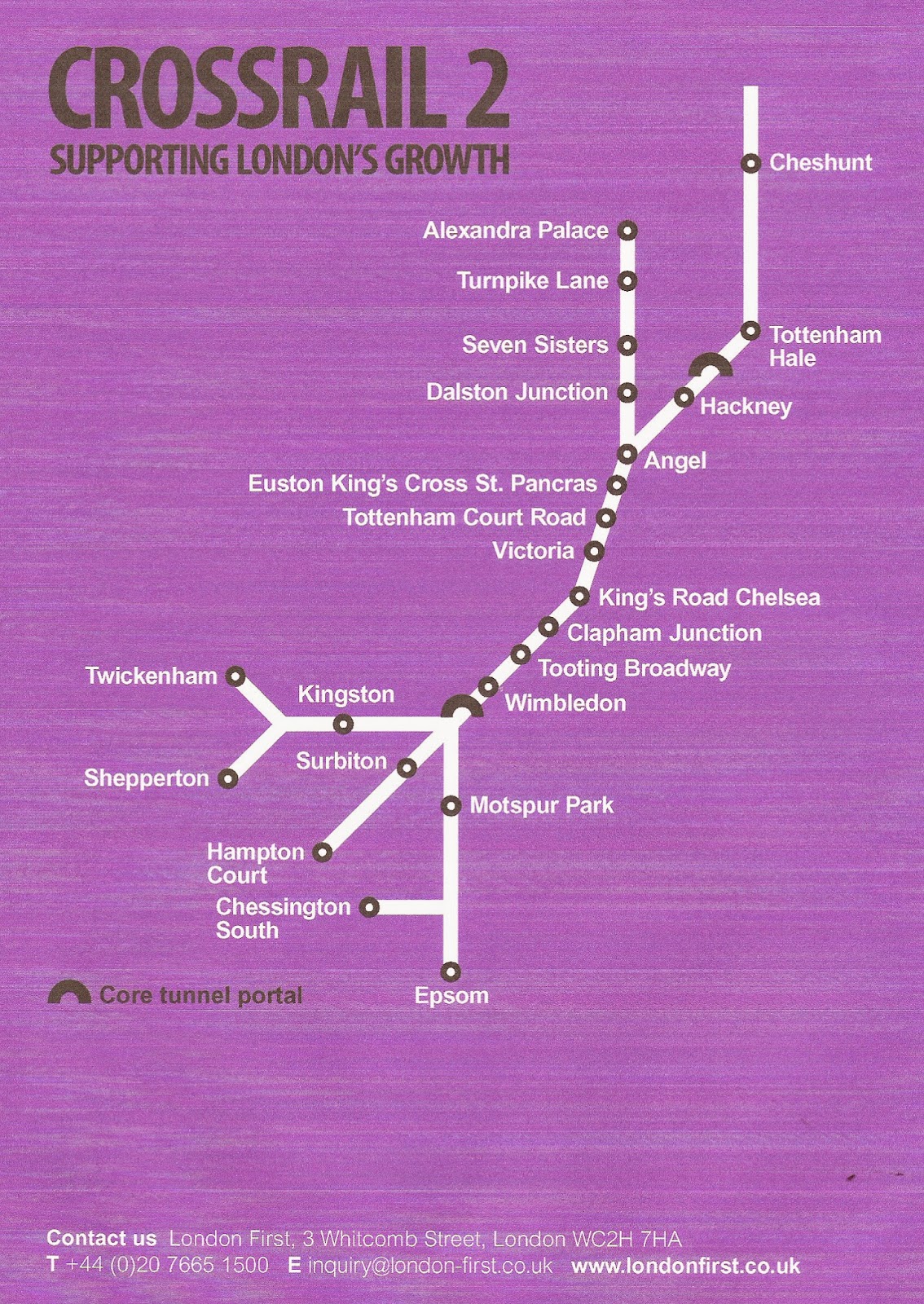


That leaves the "London First" proposal for the so-called Crossrail 2 project. It is also known as  the Chelsea- Hackney line, or in short the Chelney Line. That is how I prefer to refer to it as will be seen.

 As said in the report as prepared by London First..........
The new line, Crossrail 2, would transform journeysfor commuters from the south-west and the north-east, including Wimbledon, Kingston Hackney, Islington, Tottenham, Cheshunt and Hertford East. It would also provide essential relief to major London interchanges, including Euston, Victoria and Clapham Junction, and reduce pressure on congested Tube lines. In some cases, journey times would be more than halved.

8)-The Chelney Line:
The general direction of the line has been laid down for some years. At first it was a southwest - northeast line to cover areas, such as Chelsea and Hackney which were lacking in Underground coverage.
Now, however, we have to be more specific.
i)- The Greater Anglia lines from Cheshunt and Enfield through Seven Sisters  are to be taken over by London Overground, together with the services from Chingford, into Liverpool St. in 2015.
These services can be taken out from Liverpool St., thus freeing up platforms,  and fed under the City to form part of the Chelney Line.
ii)- I disagree with London First in that these lines should go through Tottenham Hale. I would prefer to send out the Greater Anglia services from Liverpool St. to Hertford East, Stansted and Cambridge through Stratford. The Stansted Express as well as other local stopping services can call at Stratford to provide the necessary connections. By not calling at Tottenham Hale the Victoria line will not have the connections envisaged and so will not be provided with transfer passengers to an already overcrowded line, these will then be funelled on  to the Circle Line.
iii)-The extension to Alexandra Palace and even New Southgate can be taken on from London First´s suggestion, however, I would run the line from Seven Sisters.That way the inner core could have greater frequencies of trains while reducing the construction costs.
iv)-In the inner core the number of stations and their location can be taken from London First´s plan. However, north from Kings Cross this blogger suggests stations at Essex Rd., Haggerston, London Fields to connect to Hackney Central.
v)-At the southern end of the line there would be branches to Shepperton, Hampton Court and Chessington South. These would take over the South West Trains lines to those destinations thus freeing up platform space at Waterloo.

vi)-There is a suggestion to run a service through Kingston, Teddington, Strawberry Hill to Twickenham. That, however, has its difficulties as a new flyover would have to be constructed at Twickenham into a turnback facility which does not exist - certainly an expensive option.
vii)-There is also a suggestion to run trains from Wimbledon and Raynes Park through Motspur Park and Stoneleigh to Epsom. The practicality of this would depend on other services from Victoria and Waterloo to outlying areas.


The platforms saved from surburban trains at Paddington, Marylebone, Euston, 
Liverpool St., Victoria, Waterloo provide for a broad scope to increase regional and inter-city 
trains. That way the capacity, connections and convenience of the system can do much for the 
crushed commuter.

The London rail system, though mature, still can provide a flexibility to offer a greater variety of 
services along its lines. It only needs some broad thinking and political will to increase the 
capacity so as to satisfy the demands to made upon it it in the latter part of the 21st Century.


To read more on this subject look at the blog of London Reconnections for 24th October 2014.
   
Other bloggs, I have written,  related to this subject are.....
http://trans-trax.blogspot.com.es/2013/05/getting-lines-crossed-in-london.html
http://trans-trax.blogspot.com.es/2010/05/crossrail-where-is-it-going.html


12 March 2013

High Speed Rail Lines - how to focus (other lines) 3/3


This is the third in a series of 3 articles about High Speed rail in the UK.

After writing about the routes to the Midlands, the North East and North West on their way to Scotland there is one grand high speed route that should be mentioned - the Great Western Main Line (GWML) to South Wales and the South West.

I will exclude from this review the third rail DC routes to the South and South East together with the routes to East Anglia(Kings Lynn and Norwich) as all these routes are dominated by commuter traffic so their problematic is different. Norwich might well be the exception. In any case most of these routes will be connected both north and south of London in the Thameslink programme.

Future train service patterns and operators will be determined by the DfT following a re-franchising process which is currently planned to take place in 2013. However, the intention is to link many new destinations north and south of London:


GWML: This famous line is the old GWR, or "God's Wonderful Railway", built/engineered by Isambard Kingdom Brunel. Since is was originally built to a wider running gauge than the other railways at the time it provides more space for improvement works. Also it is straighter than is the case in many of the other original lines facilitating the elevation of line speeds. It is ideal for upgrading and upgrading is what it is receiving.

The GWML from Paddington to Bristol and onwards

With the Crossrail project running from Paddington to Maidenhead this section is already being electrified and improved. Obviously the logical next step is to extend the programme to Reading to include all the local services from there into Paddington but this has not been decided as yet. Electrification of the line to Reading and on to Bristol, together with the electrification to Cardiff and Swansea has been agreed upon. Extensions from Reading to Newbury and from Didcot to Oxford are also envisaged. These are important with respect to other proposed projects. The timetables as published by Network Rail are for completion to Bristol, Newbury and Oxford in 2016, with Cardiff being completed in 2017. No date is given for Swansea - probably 2018/19.


  However much the politicians try to convince us, we know that high speed rail travel should not be limited to radial routes from London. Passengers wish to travel from different points to others without necessarily passing through London.  As I have stated previously "Rail customers want to be able to  travel safely, in comfort and at reasonable prices between
the most densely populated parts of the country", yes, but this does not mean necessarily passing through London.

Other ideas have been floated and I have compounded them into one such project which I have called the "Southern High Speed Line" (SHSL).

Firstly, there were proposals to connect Reading with Heathrow airport. This was an idea based on the assumption (a) replacing the present Railair coach service run at 20 minute intervals so taking polluting buses off the roads, and (b) at some time in the future permitting GWML trains from Bristol and South Wales to run into Terminal 5. This was not a well thought out idea and was only a bit solution in any case. This I looked at on 6th October 2011.
 http://trans-trax.blogspot.com.es/2011/10/reading-heathrow-rail-connection.html

Secondly, there was a proposal to link Heathrow and Gatwick airports, provisionally named "Heathwick". The idea was to connect the two airports with high speed trains so that they could be used interdependently. It would also replace the National Express coaches from Heathrow to/from Gatwick (100 per day).This was resoundingly and rotundly rejected by the parties affected and rightly so. I looked at this case on 11th October 2011. 
 http://trans-trax.blogspot.com.es/2011/10/heathrow-gatwick-rail-link.html

 Thirdly: add these two projects together and you can see that it is a relatively short extension from Gatwick to Ashford and the Channel Tunnel. That way you can achieve direct rail services to Continental Europe without any difficulty, to Paris, to Brussels and onwards. Is this not what the rail lobby wishes? You obtain direct rail services from the two principal London airports on some of the busiest  short-haul air routes in Europe, to Paris, to Brussels, to Amsterdam and to Cologne/Bonn. Would these not end up reducing air traffic at the two airports and by extension free up landing/take off slots for other long-haul flights?All this and without transitting through London itself!!

Fourthly; from there it is a small step to start thinking about the very same European rail services starting from Reading. If they start from Reading , why can they not start from Birmingham or Bristol? We know that these possibilities are more complicated logistically for passengers but not so difficult for freight traffic. So let us think about freight traffic going from the Midlands and the West of England directly to Continental Europe without passing through London - by avoiding London it means we can avoid a probable bottleneck.

Fifthly; If you take the arguments from there and start to think about what traffic is through traffic, that which does not want or need to stop in England on its way to Europe, then you start to think about the traffic to/from Ireland to/from Continental Europe - both passenger, but principally freight. The non-stop passenger, car, freight rail services to/from Ashford to Calais have reduced substantially the sea ferry traffic. Since this is the case then would it not be the same for traffic to/from Ireland? Obviously there is no direct link to Ireland from Britain as yet except by ferry, but, however, would it not be quicker, more comfortable, and cheaper to provide through European services (by EuroTunnel) from Ireland to Continental Europe? Obviously, since there is no tunnel from Rosslare to Fishguard (the shortest route to Calais) the train services would have to start there, in Fishguard, meaning an extension of the ferryport to accomodate the most likely extension of the services. The train link would then be non-stop from Fishguard to Calais along the GWML, the Reading-Heathrow extension, the Heathrow-Gatwick extension and on to Ashford and the Chunnel.

Would not lorry(or car) drivers find that paying for the through route by train from Fishguard to Calais better than driving that distance, considering the time, the stress and the cost? Would it not be a double winner for Britain if such through traffic were taxed on the roads so as to make the cost of travelling by road or by rail the same? Would this not be the carrot to free up the roads and also free us  from the pollution if the traffic were transferred on to rail?

All, these ideas put together  bring us to the conclusion about a a dedicated line from Fishguard to Ashford
Thus my two blogs on 24th February 2010 ...
 http://trans-trax.blogspot.com.es/2010/02/fast-trax-2-case-for-southern-high.html
..... and  15th May 2012
http://trans-trax.blogspot.com.es/2012/03/who-wants-irish.html


If such a service could be provided, especially for freight traffic then could not the same be offered for freight traffic originating in Great Britain? Of course it could.
A site next to the GWML railway, and the motorways outside Bristol would be ideal to service freight(and car/passenger traffic?) from South Wales, the West, the South West and south Midlands non-stop to Continental Europe.
From a site near Birmingham - again next to the rail lines, the airport and the motorways - would be ideal, especially for freight traffic to run down to Reading and along the SHSL to Ashford and the Chunnel.
Both projects would make a significant effect on pollution and on traffic volume.


Transpennine Routes: The electrification of the Liverpool Lime Street to Manchester Victoria line (via Chat Moss) will reduce the journey time between those two cities. Agreement has been reached to extend this electrification from Manchester to Leeds and on to York. That way the through services between Liverpool and Newcastle can run under the wires for its whole length. Unfortunately, the lines from Leeds to Hull (and Scarborough) are not due for electrification so these services will have to be diesel  wasting the benefits of electrification for most of its length. On the other hand trains could begin at Leeds but this is an inconvenience for passengers. Thus the line from Leeds to Hull (and possibly Scarborough) is an obvious candidate for electrification at the earliest opportunity.

The third service from Liverpool runs from Lime Street through Warrington Central and Manchester Piccadilly to Sheffield, Doncaster on to Grimsby and Cleethorpes. This line is not electrified so diesels would be used. The logic for electrification is obvious since line speeds would increase substantially but the economic case has to be looked at which might torpedo any such project.

Problems might well arise at the Liverpool end. The line from Wigan and St.Helens into Lime Street is to be electrified. That could well mean that intercity services from Liverpool to Glasgow and Edinburgh would restart making present constraints in the station even worse. If the demand for Transpennine services increases then the problem could become acute. Then a strong case would be made to reopen Liverpool Central station (at ground level).

This is possible since the tunnel into Liverpool Central still exists and is partly used by the Merseyrail Electrics (the Mersey Tube). However, the tunnels were built for four tracks so still could be used for mainline services into a reopened mainline station at ground level. At the terminus the site is now occupied by a supermarket. This could be solved by rebuilding the supermarket on the top of the mainline station.

This way overcrowding at Liverpool Lime Street station can be alleviated. The old CLC services along the line from Manchester Central, Warrington Central into Liverpool Central could be restored thus cutting ten minutes off the present timetable which is the penalty for running into Liverpool Lime Street. Obviously at the Manchester end the old Manchester Central station is not available so services would run to and through Manchester Piccadilly as at present, without any time penalty.

Other lines:
The cross country traffic is quite substantial whether it be passenger or freight. Therefore,the main lines connecting these points are essential.
Bristol to East Midlands and Southampton to Birmingham come to mind immediately.
Phase 2 of HS2 from Birmingham to Nottingham (and onwards) is of paramount importance for traffic from Birmingham to Bristol and onwards. Birmingham is and will be an important interchange for passenger traffic which does not want or need to transit through London. Certain line straightening from Bristol to Birmingham would be necessary to increase the line speeds so as to make the line more attractive. Add that to HS2  to Nottingham and then there is a strong route all the way from Bristol and further afield to Leeds.

The Southampton to Birmingham line has already been targeted for freight. The first part is the section from Southampton to Basingstoke and Reading. This is three DC rail electrified.
the second part is from Reading to Didcot, Oxford and Aynho(just south of Banbury and Kings Sutton) and on to Birmingham. The section from Reading to Oxford is to be electrified with AC overhead wires. The section from Aynho(or near Banbury) is to be part of HS2 from London to Birmingham. That means that all that is needed is to join the section from Oxford to Aynho - which is about 27 kms. - with overhead  AC wires. This would make the connection from the South´s main port to the Heart of England and onward to East Midlands or the WCML at fast speeds a reality.

The Felixstowe to Nuneaton line has also been upgraded. This, however, is mainly thought of as a way to facilitate freight traffic from the East Coast port to the ECML and WCML. The loading gauge has been enlarged so that the larger containers can transit the lines so facilitating greater use of rail freight and so fewer lorries on the roads. It is not really thought for passenger traffic as the line has not been straightened and so the line speeds are still reduced.

Scotland : Obviously not all the trunk routes have been mentioned. There are three principal routes between Glasgow and Edinburgh. Which of these will be dedicated to high speed traffic as against serving local traffic is something the Scots know more about than this blogger so they will decide. They are already talking about a fast route.

The communications northwards are still anchored in the Victorian era. In such a large geographical area it is essential to use rail to vertebrate the country. The main cities to be offered better communication are Inverness and Aberdeen from both Glasgow and Edinburgh.   That way other important cities get connected like Dundee, Perth and Stirling.

The Borders have not been forgotten and could well achieve better communications with this blogger´s ideas about high speed lines from Carlisle to Glasgow and Newcastle airport to Edinburgh. The main lines were explained in the first blog of this series of three. (High Speed Rail Lines - how to focus (The Scottish Connection) 1/3 (31st January 2013)

At the moment the traffic forecasts probably would not make these high speed lines through the Border region as economical as wished for.That does not mean they should not be put into effect. For that reason regional services would be ideal. With stops along the line (off the main line) passing points would be provided for. These would be for slower regional stopping trains and freight trains. That way non-stop fast trains would not be impeded. Obviously not everything has to be done at once but should be included in the plans for long term solutions.


Conclusions:
Fast rail lines fulfill a desire and a need.  New and improved lines encourage people to travel by rail as has been proven in the last decade with the upgrade of the WCML. However, speed for speed´s sake is not justifiable. 400 kph. maximum running consumes enormous amounts of energy and makes turning circles so great that the lines cannot avoid any obstacle. This would mean slashing through the landscape and taking everything in its way before it. A lower maximum speed - but still fast - such as 320 kph. is more than enough for this small island.

Is there a need for new lines? HS1 from the Channel tunnel to St.Pancras showed that there is a need. The previous route to Waterloo was unsatisfactory as HSR trains had to mix with commuter traffic.

The question is if more HSR lines are needed. The answer to that question is mixed. If the question is line capacity alleviation then a new line has to be compared to increasing the number of tracks on existing lines. Doubling a twin track line to four track does not double capacity - it is more than that. Trains that run on the dedicated "fast" or "slow" tracks run more in accordance to the preceding and following trains so the distance between trains can be less - thus more run per hour.

When increasing the number of tracks these do not necessarily have to right next to the "old" track. The new tracks can be next to or near the "old" track, but the construction would take advantage of the line(or as I have said before the corridor) of the "old" track to straighten the "new". In that way higher line speeds can be provided for.

Are new lines necessary? As the command document on phase 2 of HS2 states HS2 is based on assumptions, such as having a dedicated separate line from terminus to terminus, which makes the idea inflexible, ridiculously expensive and obviously does not consider any extensions further north.This blogger considers that new lines should be built where essential but not as an end in themselves.

The greatest needs are for new lines at Shap in Cumbria, from Gretna Green to Glasgow and from Newcastle to Edinburgh.  At Shap the fast new section of the WCML would run through the mountains from Kendal to Shap thus cutting out the roundabout route. The line from Gretna would run near to the present WCML but seperate from it almost all of its length. The line from Newcastle would have a totally different route from the present ECML to make it much shorter as well as straighter. Nobody should balk at such suggestions as we know we are talking about infrastructure for the next 100 years (or more).

The rest of new construction would be relatively short sections to improve the total journey time. The longest sections would be from Derby to Stoke, and from Ayno to Birmingham airport(if my suggestions about HS2 are accepted). Phase two from East Midlands to Leeds would have, in my suggestions, short sections coupled with upgrades. Other new sections of line are marked on the respective maps but are not of significant length.

Will these solutions be expensive? Yes, but necessary. Will they be cheaper than the HS2 proposals? I do not doubt most of my suggestions would come out cheaper when all costs are taken into account. However, costs should be looked at in two distinct ways. The capital costs are an investment in improving infrastructure to satisfy the needs of the travelling public so would need to be accepted per se. The running costs of the improved services, when they are implemented, have to be controlled strictly so that the rail service for the general public can be offered at reasonable prices without necessarily losing money.  It is very noteworthy that SNCF, the State French Railways announced on 20 February 2013 the setting up of a cut price HSR service called OUIGO . SNCF unveils cheap high-speed service (ref: Rail.co website). This will provide, initially, a cheap TGV service from Paris to Lyon, Montpellier and Marseille.

The relevant question is why? Obviously, if all the capital costs of new projects  are included into the cost of a new line then it will never maker a profit. The sales price has to be such that the clientele use the service and there can be a profitable return, the public are not scared away by the ticket prices. SNCF obviously, want to fill up the TGV lines to capacity.  


However, remember, the capital costs can be allayed by subsidies from the European Union to a great extent so reducing the cost to the local market. The Trans-European Transport Network Executive Agency was set up by the European Commission to help fund trans-European transport projects,so some or all of these projects qualify.

As a last point we should look again at the way benefits can accrue from High Speed rail lines as pointed out by the World bank and published here in Rail.co 22 Jan. 2013

N.B: Take note of these articles also....

"Speed not enough to entice people onto HS2"
http://buyingbusinesstravel.com/news/0416138-speed-not-enough-entice-people-hs2

"HS2 In Favour and Against" 

 http://trans-trax.blogspot.com.es/2011/07/hs2-in-favour-and-against.html


22 February 2013

High Speed Rail Lines - how to focus (HS2 and to Leeds & Manchester) 2/3


This is the second in a series of 3 articles about High Speed rail in the UK.

The publication of the government´s policy document in January 2012 entitled  "Review of the Government´s Strategy for a National High Speed Rail Network"  laid out ideas for fast rail transport. On 28th January 2013 under the title "HS2 phase two initial preferred route plan and profile maps"the specific ideas for the extension of HS2 from Birmingham to Manchester and Leeds were published. This document looks at both phase one and phase two. Also published by the DfT on that date was the accompanying document to justify the choices made titled  "High Speed Rail:  Investing in Britain’s Future –Phase Two: The route to Leeds, Manchester and beyond"


This blogger works under some assumptions which have to be repeated.
(a)- we wish to have faster trains to the most populated parts of the United Kingdom so that rail customers can travel safely, in comfort and at reasonable prices to the most densely populated parts of the country;
(b)- The country is (relatively) small and densely populated so any new lines (long or short) have to be carefully thought out so as to make as small an impact as possible on (in this order) homes, other residential areas, other important property, industry and workplaces, recreational areas, and the unspoilt countryside in general;
(c)- Existing transport infrastructures and their corridors should be used as much as possible to reduce the impact of new construction;
(d)- New transport projects should work to connect existing transport nodes and promote the use of public transport so as to reduce the dependency on private car transport;
(e)- Any new transport construction should be developed so as to make the most efficient use of energy, and reduce the toxic and noise pollution from the most offending vehicles,thus leading to their reduction in use and the liberation of space on public ways.
(f)-The existing rail corridors should be recognised as such, and therefore, accepted as being the main arteries of the country. They should all consist of four tracks of rail (next to or near each other) so that there can be a separation of fast rail from regional, local and freight services but interconnecting in case of need (for emergencies or maintenance). 

What this blogger rejects are...
(i)- speed for speed´s sake
(ii)- projects which demand great quantities of resources over and above what is necessary to provide a good, reliable, quick rail service
(iii)- projects which marginalise a large proportion of the population unnecessarily
(iv)- projects which promote private car transport thereby defeating the objective of clean, environmentally friendly  transport
(v)- projects which carve up and scar the countryside where alternatives exist 
(vi)- projects which become self serving to the interests of political, financial, technical and legal groups to the detriment of the public good.
(vii)- nimbyism for nimbyism´s sake.


 --------------------------------------------------------------------------------------------

In the previous blog I looked at the two main north-south trunk rail lines connecting London with the north west and Glasgow  via the WCML on  one side, while the ECML connects London with Leeds, York, the North East and Edinburgh on the other side of the Pennines.

With the High Speed line (HS2) from London to Birmingham approved and progressing (at least in the planners´offices), I think it is time to look again at the problems and try to sort out solutions for this small island of ours. HS2 has as its basic idea to link London with Birmingham with the eventual proposal to link Birmingham with Manchester and Leeds in two separate branches. This article tries to look at the proposals in a critical way.

It is recognised that there is a shortage of line capacity on the West Coast main Line (WCML) which will become acute in the next ten years. This is, mostly, on the section from Rugby to London.The problem is particularly bad with local stopping services and regional services. Commuters suffer from overcrowded trains, especially in the rush hours and there are no paths for more trains. The intercity trains also have no more paths available. For that reason trains are being extended from 9 to 11 carriages. Some stations, think of the Trent Valley stops, are not served as well as they should be. They, thus, reduce the number of passengers and  the possible revenue for the rail companies while increase the road traffic to satisfy the demand.
This is the principal reason for the desire to build HS2 from London to Birmingham.

The time lag mentioned in the documents published in January 2012 suggests the new HS2 to the West Midlands will be operational in 2022 while the extensions to Manchester and Leeds will take another eleven years, up to 2033!!! That is 20 years from now to see and be able to use a mode of transport which only partially solves the problem. A good straightforward explanation of the steps needed in getting HS2 started is given in an article in "The Rail Engineer" (11 February 2013) titled "High Speed Interest"

This blogger thought it best to split HS2 into three parts and so deal with each separately.

* * * * * * * * * * * * * * * * * * * * *

-The white line indicates the route decided for the rail line from London to Birmingham and the proposals of HS2 Ltd.to the government from Birmingham to Manchester and Leeds.
-The black line indicates the present classic line in the respective corridors.
-The green line indicates the classic line widened and upgraded to four tracks.
-The purple line indicates a new two track fast section of line to complement the classic line.
-The dark blue sections are parts of the new two track fast section in a tunnel.
-The lighter blue sections are those which combine short new sections combined with upgraded classic sections of line.


* * * * * * * * * * * * * * * * * * * * * *


1) - HS2 London to Birmingham (The Chiltern Corridor):
 

The newly established (white) route leaves Euston in a new tunnel to Old Oak Common then continues along the present Chiltern Line /LUL corridor from North Acton to West Ruislip (almost at the M25). From there it steers northwest, south of Amersham, south of Aylesbury, north of Leamington Spa while south of Coventry to an out-of-town stop near the National Exhibition Centre at Birmingham. One section then branches off to enter into Birmingham City Centre via Water Orton to a new city centre station at Curzon Street between New Street and Moor Street stations. The other sector branches off northwards to join the WCML between Lichfield and Rugeley.

The route that this blogger proposes runs from Paddington through Old Oak Common, along the present Chiltern line (upgraded to four track) to east of Beaconsfield, then along a new two track fast stretch, including a tunnel under Hazelmere(10.6 kms.) to finally rejoin the Chiltern line west of Princes Risborough. The route then continues along the Chiltern line (upgraded to four track) to Aynho (just south of King´s Sutton). from there the route is new up to the WCML just east of Birmingham International Airport. from there the trains can run on the present (upgraded) WCML into Birmingham New Street or northwards to join the WCML just west of Lichfield Trent Valley station.

According to my calculations the HS2 route from Old Oak Common to Birmingham Curzon Street is 166.6 kms. while using a combination of Chiltern line (Classic route- CR) together with new sections the route would work out from Old Oak Common to Birmingham New Street to be 166.0kms. The saving in distance would be 600 meters, not a lot over such a distance but something.

The real savings would be others. The HS2 line is all new, will be hidden as much as possible in tunnels and cuttings but is tremendously obtrusive in (as yet) unspoilt areas. This blogger´s proposal is less obtrusive since it uses an already existing corridor for more than half its length. For the other sections it can still use tunnels and cuttings to reduce its environmental impact. The HS2 proposal in effect demands the construction of half a new station at Euston, a new station at Birmingham Curzon Street and a completely new station, out in the boondocks on the wrong side of the National Exhibition Centre outside Birmingham requiring a twenty minute walk to the airport.

This means a Birmingham Parkway station where people can access it by car thus providing the excuse to use a car and not public transport. This negates the purpose of public transport. Public transport, as usual, will be poor and far between, basically serving the poor, infirm, aged and students - only operating during the busy times of day. Who would want to be stuck out at such a station waiting for a bus at 10.30 pm.? The Euston station station means an unnecessary tunnel to it from Old Oak Common coupled with lots of housing to be demolished, just so developers can erect office blocks over the station - something they forgot to do with the rebuilt Euston of the 1960s. With Crossrail subtracting services from the station Paddington can provide platform capacity for HS2.

The station problems in Birmingham are unique. New Street, Moor Street and Snow Hill are all important termini (or city centre stations). the possibilities of rebuilding and extensions are limited so a new station at Curzon Street might well be necessary. It all depends if Curzon Street is to be a terminus station or if the HS trains will continue through Birmingham City centre to population centres beyond (this is what the French do). However, what must be ensured are the connections between them - albeit through underground walkways, but protected from the weather in any case.


2) - HS2 Birmingham to Manchester/Preston (The WCML corridor):


The connection from Birmingham northwards to Manchester and Wigan is clearly more problematic.   It is just as well that it it is only a recommendation and not definitive as yet since it is totally unjustifiable.

From Lichfield the HS2 has a connection to the WCML from where it also continues on a roughly parallel route north of the WCML to Crewe for a distance of 61 kms.


However, if we ignore this section all trains could run on an already upgraded four track railway all the way from Lichfield to Crewe - the WCML. The present track gives a running potential higher than the legally permitted speed. The following improvements would make it much faster-
Incorporating short sections of new or improved line from......
(a) Colwich to Stafford East of 6.86kms.
(b) the Stafford underpass (for through trains to avoid the curves) of 4kms.
(c) a short stretch of line to be straightened at Norton´s Bridge 3.6kms.
(d) a short stretch of line to be straightened at Baldwin´s Gate 4.35 kms.
all these to be two tracks supplementing the present four track system.
This means a track improvement of 18.81kms. between Lichfield and Crewe

The difference between the two proposals makes for 42.19 kms of construction which are not necessary.


On page 41 of the command document for phase 2  is shown the proposed underpass for Crewe. This is necessary for all trains north-south as well as south-Manchester ones which do not stop at Crewe. HS2 Ltd´s proposal means the line to Manchester runs there on new track after leaving the town to the north.


I disagree with that proposal. I suggest the line branches off to Manchester in the underpass emerging outside the town to join the present Sandbach - Holmes Chapel WCML line outside Crewe after passing under the town and branching off northeastwards under the town. The main WCML can continue northwards and emerge outside the town on the outskirts at Leighton. It then continues northwards on the present WCML.

On this route the line is mostly fast two track to Warrington but this can be remedied to four track.without any great problems. The trains to Liverpool would branch off to Runcorn at Weaver Junction as at present, while the North West and Scotland trains would continue up the present WCML to Warrington. The line is relatively straight and the work needed to four track it would come to 22.25 kms. in total

From Warrington to Wigan there is just one section which needs to be fourtracked  of 4.56kms. Then the whole line from Crewe to Wigan would be fourtracked but with no great major works north of Crewe.. This total of updated lines comes to 26.81kms.

From Wigan the line runs up to Preston but would need to be fourtracked from Wigan to south of Euxton for 12.4 kms. This is about half the distance to Preston but would mean the line is fourtracked all the way to that station. What is problematic is the curvature of the WCML through Wigan North Western station (this is not a problem at Warrington Bank Quay) together with the length of the platforms for long HSR trains. These two points have not been mentioned at all in the command document produced by the DfT.


The  line from Crewe to Bamfurlong : HS2 Ltd. is proposing a completely new line to branch off the present  WCML north of Crewe to travel in the direction of Altrincham. One section would then turn left to pass east of Warrington to rejoin the WCML just south of Wigan at Bamfurlong (north of Golbourne). This section is unnecessary carving up of the countryside and marginalising Warrington which is an important provider of passengers for long distance services on the WCML (more than Wigan). The HS2 proposal is 49.2kms. while the WCML alternative is 50 kms. The latter route, however, is cheaper and much less disruptive.

From Crewe to Manchester the HS route goes along the same line to Altrincham where it turns right just below the M56 motorway towards Manchester airport. The M56 then turns north east and here where the HS2 crosses the motorway, between Warburton Green and Davenport Green, an interchange station is planned. This would be on the left side of the motorway some distance from the airport terminals and in my opinion is a very bad option. 

If the WCML is taken from Crewe through Sandbach, Holmes Chapel and Wilmslow the line can branch off left along the existing tracks into the airport to stop at the existing terminal station. Better it would make it for the line to continue west out of the airport to then turn northwards to follow the proposed line through Didsbury to Piccadilly. This extension through the airport does not have to be particularly disruptive as it could be laid between the motorway link road and  terminal 2 - even better would be for the rail to go underground just at this point before turning right towards Manchester. To make the whole line from Crewe to the airport four track would require upgrades of two sections: one from Sandbach through Holmes Chapel of 13.7 kms. while the other section is from Chelford through Wilmslow into the airport of 14.0 kms.

The HS2 line from the airport into Manchester from this point goes undergound to emerge just north of Longsite before entering Piccadilly. I agree with this route. This line only needs to  be two track. It should be remembered that the lines entering Manchester are multiple from Crewe and Stafford so give various options in case of need - accident or maintenance.  In that case just one line need be four track while the others can remain two track.


HS2 Ltd´s proposal for the route into Piccadilly from Crewe means 50.7 kms. of new construction added to the extension of 26.54 kms. to Wigan  . My proposal to build a new line from the airport into Piccadilly means just 16.2 kms. of new construction. This is a significant saving to achieve better results.

The total of new HS2 construction on the two branches from Crewe to Manchester Piccadilly and Wigan come to 77.24kms. On the other hand the improvement of the WCML through Warrington to Wigan plus the lines from Crewe to Manchester Piccadilly mean just 16.2 kms. of new construction plus 54.51kms. of upgraded lines. The added advantage of the second option is that the fast line actually goes through Manchester airport (and not stop at some considerable distance from it), the potential traffic to/from Warrington is included, and also of paramount importance, unnecessary scarring of the landscape is avoided. It should not be forgotten also that Warrington Bank Quay is the transit point for Chester and North Wales for passengers from the north.


3) - HS2 Birmingham to Leeds (and the MML corridor):


In this section we must subdivide the line into four parts:

A)- Birmingham to East Midlands:
The HS2 line leaves Birmingham just north of the Water Orton line into the city centre to branch off northeastwards parallel to the M42 and A42. Having passed Ashby-de-la-Zouch it then passes under East Midlands airport to end up at Toton (to the west of Nottingham). This new section from Birmingham city centre to Toton comes to 70 kms.
 While this blogger agrees with the route in general terms I would like to point out some details.
I see no need for the line to pass under East Midlands airport at all. It is unnecessary expense. It could curve round south of Kegworth (instead of north) to join the Midland main Line (MML) just south of the East Midlands airport station. In that case if the HS2 line stops at Birmingham airport instead of another station on the other side of the National Exhibition Centre, it would then stop at East Midlands airport station thus connecting the two airports. Connectivity is what we strive for, do we not?
I consider a stop at the East Midlands airport necessary for services to Derby and onwards, as will be shown later, but also for services on other classic lines to other population centres north of Nottingham.
One point to bear in mind is the desire, or not, to leave the door open for fast regional services (such as SOUTHEASTERN ´s from North Kent into St.Pancras on HS1)as well as  HSR intercity services. This would be done if the demand were not so great for the intercity services while there could be a strong demand from  intermediate population centres. Then a stop could be built at Ashby-de-la-Zouch. 
My last point here is to criticise the choice of Toton as a stop, which only promotes car usuage. but I will develop that in a moment.


B)  East Midlands to Stoke-on-Trent:
On the map I have published (courtesy of Google Earth), you will notice that I have included a line to Stoke-on-Trent. A link from the MML (newly electrified) to Derby is a must, without question. The point is this. If you improve the line from Derby to Stoke then you can offer another entrance into Manchester. The present service is slow and not competitive. However, with improved times you can offer alternative services, serving important population centres (including between themselves), and direct into St. Pancras for HS1 services to Paris and Brussels. East Midlands Trains would thus be in a position to offer realistic competition to Virgin Trains (assuming the same operators are the franchisees in the future).

As can be seen on the map two short upgraded sections  (meaning to four track) would be needed from East Midlands airport to Derby (15.8 kms.) and from Blythe Bridge into Stoke (11 kms.). The section between is too curvy to be used as a fast line so a two track fast line of new construction would be built of 41 kms.. Such a new line would improve connecting times from Stoke (and thus from Manchester) to East Midlands (and thus St.Pancras). The building of this can be much quicker than HS2 thus dampening down demand on the WCML and offering alternative capacity in a much shorter time span. The savings on the envisaged investment (as mentioned before) for the destructive swathe through Cheshire could be devoted to this project.

C) East Midlands to Leeds:
The line from East Midlands to Leeds is perhaps the most important and most needed of all those proposed in this group. However, from where it leaves and which cities it touches determine its route which is not necessarily the best available.

The idea is for the HS line to follow the line of the M1 motorway  to Duckmanton (to the east of Chesterfield) from where it would continue north to go midway through Sheffield and Rotherham rejoining the line of the M1 just south of Meadowhall. From there it would branch off the M1 to go past Cudworth, Royston, Normanton and Mickeltown. From there it turns left along the river then south of Hunslet into the centre of Leeds.
The York branch would continue north from Mickeltown to follow the line of the M1 to the north of Garforth and Mickelfield, and from there to join the Leeds-York mainline north of Church Fenton.
This involves totally new construction of almost 135 kms.

South and West Yorkshire has a plethora of rail lines constructed in the 19th century which do not all serve the needs of the 21st century. The best route to Leeds is through Wakefield from Doncaster and the ECML. This route will continue to compete with the HS2 route through Sheffield. It does not subtract, however, for the need to mark a fast line through south and west Yorkshire to Leeds.

The basic errors of the proposed line is to have the East Midlands station at Toton, outside Nottingham, the South Yorkshire station at Meadowhall (which is nearer Rotherham than Sheffield) ending in a terminus at Leeds New lane, while the main line continues north ignoring Leeds to join the ECML on the way to York. Of course, one decision leads to another which eventually determines the whole route´s trajectory. Thus one error leads to another. It is necessary, therefore, to look at the basic premises.

A completely new line, completely separate from any other is a basic error. It is extended throughout the whole HS2 project but is totally unnecessary.  Obviously if that is the premise then the alignment draws itself. HSR trains can, do and should run on classic lines as well.

Out-of-town stations are not acceptable.These Parkway stations are based on the idea of driving to the station and parking there. This error should have been recognised by now. It promotes the use of the car (a heavily polluting vehicle) just for the benefit of those who own a car or who have access to one for journeys. It ignores the sector of the population which does not benefit from the use of the car. Public road transport is ignored. Access to the fast rail lines should be in city centres - this is where public transport goes. Point to point travellers want to go to city centres for business, pleasure or onward travel. We want to ensure that city centres remain living and vibrant  thus helping their continual renovation.  Parkways do not do this. Thus the premise is so very wrong.

What is to be done?  If we start the HS2 line from East Midlands airport then it should be taken through Nottingham. Firstly along the upgraded classic line then from Attenborough station the line would curve first south then northwestwards under the city centre with  the station underneath the present city centre station. From there this new line would go northwest to emerge overground between Nuthall and Bulwell. Then on it would run next to the M1 motorway to just south of Bolsover  where it leads to Sheffield entering a tunnel on the outskirts of the city emerging again near Kenninghall Road to connect to the classic line into the Sheffield city centre station. the line then runs on the classic line through Meadowhall and then left alongside the M1 to emerge north of Chapeltown  before the end of the tunnel and then continue to the west of the M1 along a new line to Barugh Green where it rejoins the classic line. From there the upgraded line continues north to Horbury where a new section is constructed past Tingley to rejoin the classic line east of Morley. Then the upgraded line leads us into Leeds(main station).

D)   Leeds to York:
 HS2 Ltd. envisages a branch off the line to Leeds to go to Church Fenton to service intercity trains to York and the North East. What is conveniently forgotten and not mentioned in the 108 page command document   is that the electrification of the Liverpool (via Chat Moss) line to Manchester Victoria is to be extended to Leeds and on to York. This will enable the Transpennine trains to travel under wires from Liverpool to Newcastle. Why is most of this investment from Leeds to York going to be ignored and wasted?

The conclusion reached is that, of course, a new branch line has to be built because the decision to run Leeds trains into a new station has already been made. This is scandalous. Unnecessary contruction (19.7 kms.) thus unnecessary expense. What is wrong with running any Teeside or Tyneside trains through Leeds main station? The question of a new station in Leeds is the moot point. A new service/maintenance depot will be needed without doubt. That does not mean a new station by any means. There are accessible  yards available for conversion at Hunslet, or land for a new depot at Kirstall, or even other places. Destruction of existing buildings at New Lane is unnecessary and expensive in the city centre.


The four Main Line Rail from London northwards:
In the previous blog (the first in this series) I mentioned the ECML and WCML and how they could be upgraded to achieve significant savings in time for services to the  North East and Edinburgh, on one side and to the North West and Glasgow on the other.
The picture below illustrates how HS2 fits in with these two routes plus the Chiltern Line and MML.
It can, thus, be seen that the four routes should really be taken together and how each can aid the others. This way capacity problems can be achieved all together. HS2 is then seen to be part of these but not separate from them so should not be treated separately.

The four Main Line Rail Corridors from London northwards (with HS2)


Conclusions:
The remarks here will be limited to the four main trunk routes with HS2.

HS2 is based on assumptions, such as having a dedicated separate line from terminus to terminus, which make the idea inflexible, ridiculously expensive and obviously does not consider any extensions further north. Any other considerations except the ECML and the WCML from York and Preston northwards are uneconomic, most likely not to be built, unworkable and, therefore, unacceptable. The solutions to that I have given in the previous post.

Phase One - the Chiltern Route to Birmingham - could have been drawn closer to the Chiltern Line itself but since the idea is to have a separate line having no relation to other lines except at the Birmingham end then it results in being isolated. This would be a gross error if ever an accident happened (heaven forbid) or when the line needs maintenance. The whole system would be closed. An illustration of this has been the closures of the MML and the ECML the last few days because the overhead lines came down. As explained in Railnews on 14th and 20th February 2013 respectively .................
"Major delays after overhead wires collapse"
 "Second overhead line failure strands hundreds"
............... and these two lines are major interconnected ones. Can you imagine the troubles caused on HS2 with no alternative routes to use? This would be an invaluable promotion for airline use.

The idea of fast lines must be, out of necessity, four tracks per corridor - two for intercity and two for regional traffic. They do not have to be running together for the whole length but must be connected for the reasons stated previously. That way they can be run separately but do not carve up the countryside as much as a completely new line.

I have said before and repeat that the station at Euston means unnecessary tunnelling and housing destruction in London - running the line into Paddington is quite sufficient. The placing of an out of town Parkway station nowhere near anywhere anybody wants to go has no justification. Connectivety is the key - this means using the airport station at Birmingham (it is meant to be a through station anyway). Also what should be mentioned is that all the trains to Birmingham need not necessarily terminate there - the command document admits this. Some will continue elsewhere to Woverhampton or Shrewsbury or some other place - therefore, they will need to go through a through station such as New Street. Is Curzon Street so necessary?

Phase Two: The extension to Manchester is a totally, superfluous, elephantine, expensive project dreamed up by consultants imprisoned by their narrow/constricting briefs and a scandalous destruction of countryside just where the options of entry to Manchester are multiple and so flexible. They are easily expanded without destroying so much green land.

The extension to East Midlands is a totally different question. It is quite a necessary addition to the national network. This is especially true when you consider a Southwest Northeast axis from Bristol to the North east. Is it so necessary now? I doubt it.  Of much more importance is the upgrade of the MML to the East Midlands airport. Add to this the extensions to Derby, Stoke and Manchester and then you are providing real alternatives(and competition) to the WCML.

The extension northwards must go through Nottingham - the city centre is where people want to travel. The same I say for Sheffield and into Leeds city centre. Through trains would go to Teeside or Tyneside making the spur to York superfluous, as well as the separate city terminus. The command document itself says "...the Government´s initial preferred option for the connection would also enable trains to continue to destinations further north on the East Coast Main Line,...."(p.54)

It is astounding that the planners hide behind such phrases as " the level of demand for rail travel from the region (South Yorkshire) would not make it one of the larger markets for HS2.." "...serving South Yorkshire alone would support only an infrequent service."(p.50) All this, and more, is said, without any support, to justify an out-of-town station near Sheffield  while conveniently forgetting that at present to move south it is much quicker and more convenient to use the car on the M1 next door than take the train. Many passengers in the region already have decided to use the ECML services from Doncaster. The electrification of the MML (before more upgrading) will give a much better idea of passenger demand.

These are just examples but the command document is full of self justifying arguments, apparently based on whims more than facts. It seems that this project has reached a stage of being an unstoppable bulldozer of interests more than a really interesting project for the greater number and the greater good. It is time for a rethink, preferably with other consultants, under more moderate criteria.

Thus the important projects which should have priority are
a)  the electrification and upgrading of the MML to East Midlands airport station would mean 71.7kms. of upgraded track (to four)
b) the electrification and upgrade of the route East Midlands - Derby - Stoke (to connect into Manchester) This would mean 41kms. of new construction with 26.3kms. of upgraded line.
c) a new and upgraded line from East Midlands airport through Nottingham and Sheffield to Leeds. This would mean 31.75kms. of upgraded line(to fourtrack)  with 83.5kms. of new construction


These are much more realistic figures to achieve better results.


Please note:
These are previous thoughts on the subject of HS2R
http://trans-trax.blogspot.com.es/2010/02/fast-trax.html
http://trans-trax.blogspot.com.es/2010/02/fast-trax-3-and-where-do-high-speed.html
http://trans-trax.blogspot.com.es/2010_03_01_archive.html
http://trans-trax.blogspot.com.es/2010/03/fast-trax-conclusion.html
http://trans-trax.blogspot.com.es/2010/03/high-speed-rail-2-white-paper-1.html
http://trans-trax.blogspot.com.es/2010/03/high-speed-rail-2-white-paper-2-ermini.html
http://trans-trax.blogspot.com.es/2010/04/high-speed-rail-2-white-paper-3-west.html
http://trans-trax.blogspot.com.es/2010/04/high-speed-rail-2-white-paper-4-and.html
http://trans-trax.blogspot.com.es/2011_07_01_archive.html